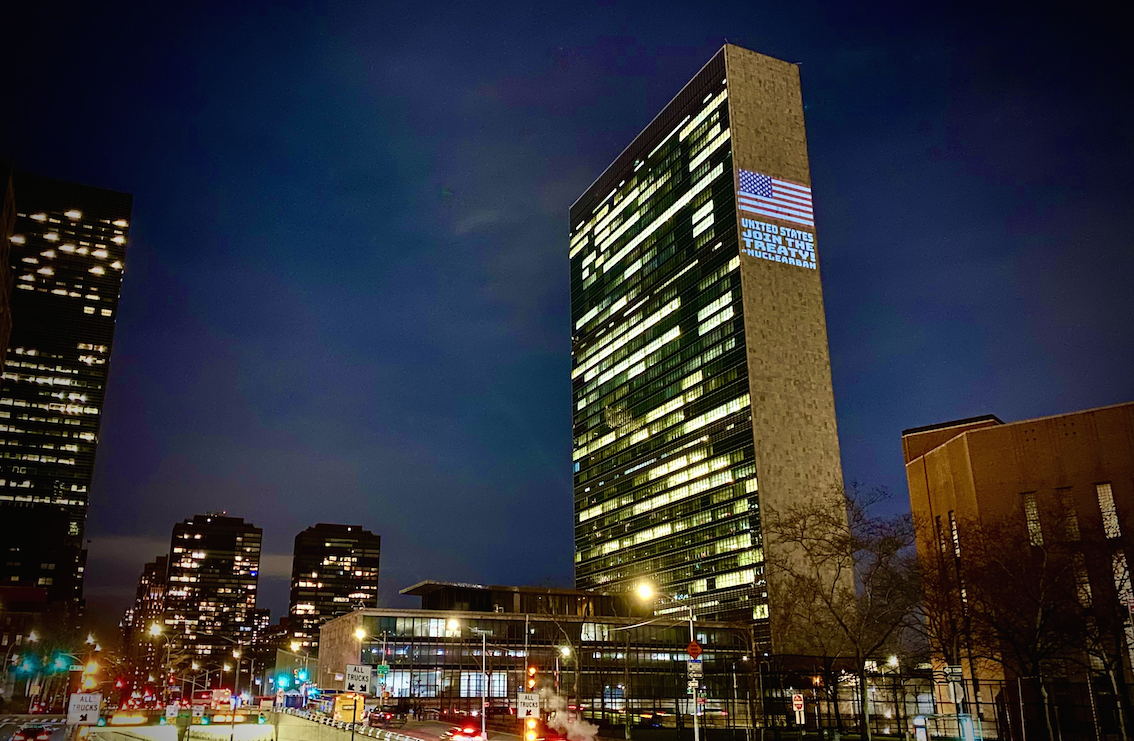
The United States has not yet signed or ratified the Treaty on the Prohibition of Nuclear Weapons (TPNW).
National position
The United States has consistently voted against an annual UN General Assembly resolution since 2018 that welcomes the adoption of the TPNW and calls upon all states to sign, ratify, or accede to it “at the earliest possible date”.
In 2021, the then-secretary of state of the United States, Antony Blinken, said: “We do not support the Treaty on the Prohibition of Nuclear Weapons. Seeking to ban nuclear weapons through a treaty that does not include any of the countries that actually possess nuclear weapons is not likely to produce any results.”
Along with other nuclear-armed states, the United States has said that it does “not accept any claim that [the TPNW] contributes to the development of customary international law”. It has called on all states that are considering supporting the the TPNW “to reflect seriously on its implications for international peace and security”.
In 2020, with the TPNW’s entry into force imminent, the United States called on states that had already ratified the treaty to withdraw their support. None did so.
A message projected onto the UN headquarters in New York in 2022 calls on the United States to join the TPNW. Photo: ICAN
Atomic bombings
The United States is the only country to have used nuclear weapons in war. In the final days of World War II, it detonated two atomic bombs over the Japanese cities of Hiroshima and Nagasaki, killing more than 200,000 people instantly or within a few months of the attacks.
Many thousands more died in the years following the bombings from illnesses caused by their exposure to radiation. Most of the victims were civilians.
Photos and illustrations of victims of the US atomic bombing of Hiroshima, as displayed at the Hiroshima Peace Memorial Museum. Photo:Wikimedia
Nuclear-weapon programme
The United States possesses approximately 5,177 nuclear weapons, which it can launch from missiles, submarines, and aircraft. Its intercontinental ballistic missiles are based in silos in Montana, North Dakota, and Wyoming.
In 2024, the United States spent an estimated US$56.8 billion to build and maintain its nuclear forces.
The United States conducted 1,030 nuclear tests between 1945 and 1992, most of them in Nevada and the Marshall Islands, but some of them over the Malden and Kiritimati islands, Alaska, Colorado, Mississippi, New Mexico, and the Atlantic Ocean.
Political developments
The state legislatures of California, Oregon, New Jersey, and Rhode Island have passed resolutions in support of the TPNW, and several members of the US congress have pledged to work for their country’s signature and ratification of the treaty.
Dozens of cities across the United States, including Boston, Los Angeles, New York City, Philadelphia, and Washington, DC, have also appealed to the US government to sign and ratify the TPNW. In 2021, New York City resolved to pursue the divestment of public funds from nuclear weapon makers in response to the TPNW’s entry into force.
Public opinion
A public opinion poll conducted by Cint in 2023 found that 68 per cent of US citizens support the TPNW, with 25 per cent opposed and 8 per cent having a neutral view.
An survey published in 2021 found that there is “baseline support” for the TPNW in the United States of around 65 per cent of the public.
Campaigners mark the second anniversary of the TPNW’s entry into force outside the White House in Washington, DC, in 2023.
TPNW negotiations
The United States did not participate in the negotiation of the TPNW at the United Nations in New York in 2017 and thus did not vote on its adoption. On the opening day of the negotiating conference, it organised a gathering of several states to protest the treaty-making process.
In 2016, the United States voted against the UN General Assembly resolution that established the formal mandate for states to commence negotiations on “a legally binding instrument to prohibit nuclear weapons, leading towards their total elimination”.
The United States actively discouraged other states from supporting the resolution.
In a document sent to members of the North Atlantic Treaty Organisation (NATO) ahead of the vote, the United States “strongly encourage[d]” members to vote against the resolution, “not to merely abstain”. In addition, it said that, if the treaty negotiations do commence, allies and partners should “refrain from joining them”.
A Japanese paper crane sits on the empty desk of the United States during the TPNW negotiations in New York in 2017. Photo: ICAN




 United States