Ghana has signed and ratified the Treaty on the Prohibition of Nuclear Weapons (TPNW).
Signature and ratification
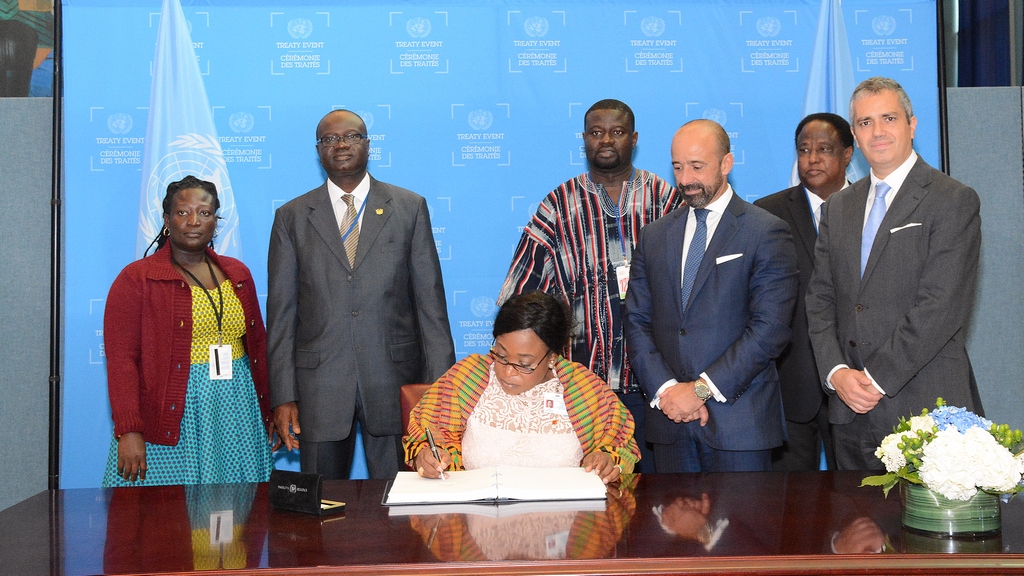
Shirley Ayorkor Botchwey, the then-minister of foreign affairs of Ghana, signed the TPNW at a high-level ceremony in New York on 20 September 2017 when it opened for signature.
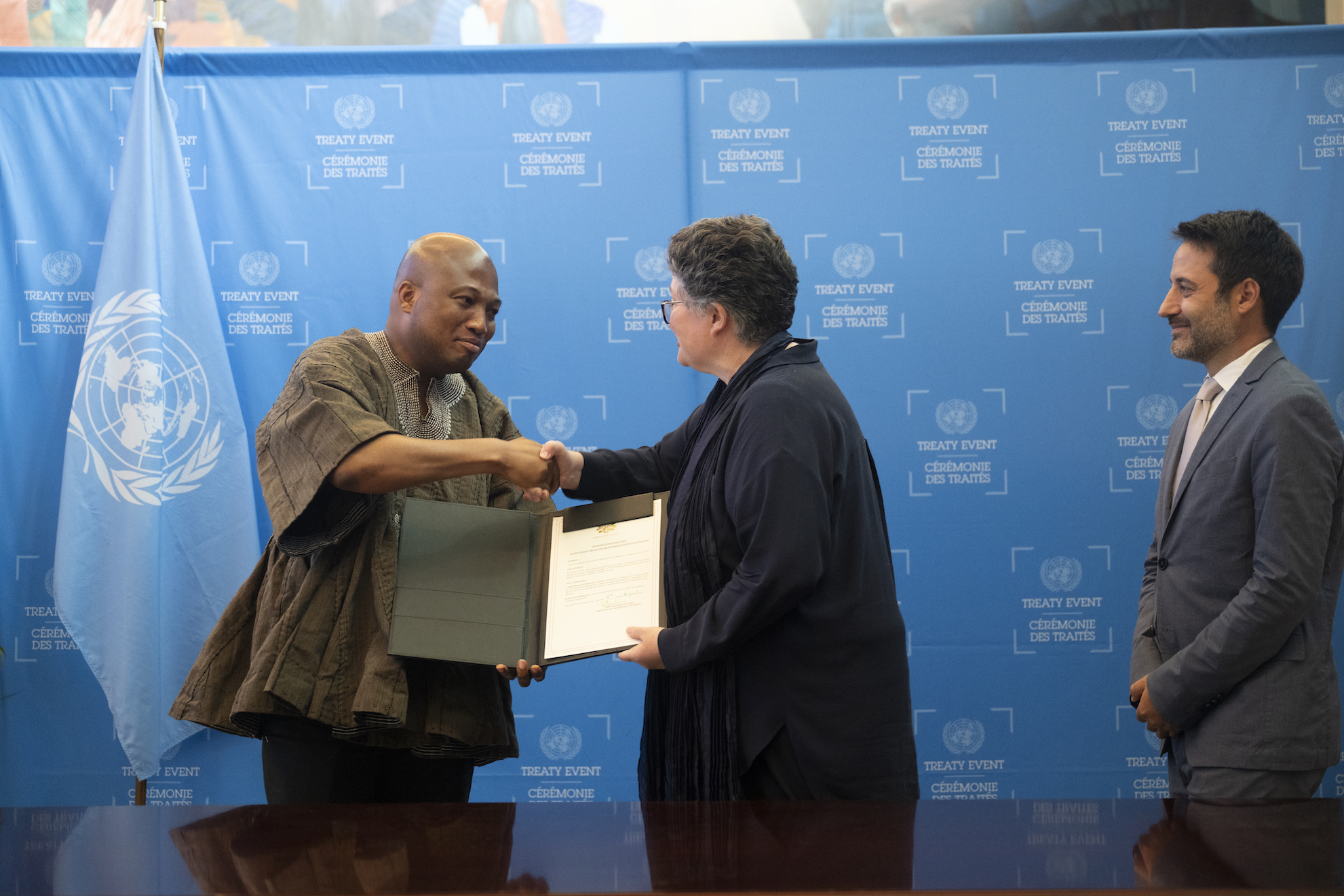
Her successor, Samuel Okudzeto Ablakwa, deposited Ghana’s instrument of ratification with the UN secretary-general on 26 September 2025, the International Day for the Total Elimination of Nuclear Weapons. He described it as “a historic day for Ghana”.
“Ghana boldly demonstrated to the world that we shall be a nuclear-weapon-free state by depositing our instrument of ratification,” he said, noting that Ghana’s first president, Osagyefo Kwame Nkrumah, had championed nuclear disarmament in the 1960s and “would be absolutely proud of this moment”.
On 23 July 2025, the parliament of Ghana unanimously resolved to ratify the treaty. “The ratification of the [TPNW] by Ghana is both a reaffirmation and consolidation of the country’s historic commitment to global nuclear disarmament and the pursuit of international peace and security,” said Alfred Okoe Vanderpuije, the chair of the parliament’s committee on foreign affairs.
“In the current global climate – characterised by heightened geopolitical tensions and a renewed risk of nuclear confrontation – the universalisation of the TPNW has become a matter of urgent moral and strategic necessity,” he added.
Shirley Ayorkor Botchwey, the then-minister of foreign affairs of Ghana, signs the TPNW in 2017. Photo: UNOLA
The minister of foreign affairs, Samuel Okudzeto Ablakwa, deposits Ghana’s instrument of ratification in 2025. Photo: Darren Ornitz / ICAN
National position
Ghana welcomed the TPNW’s entry into force in 2021, noting that the treaty “provides a universally agreed path to the total elimination of nuclear weapons” and “has revived the disarmament debate”.
“As the only legally binding global treaty that outlaws nuclear weapons, Ghana believes that the [TPNW] helps to address the existing loopholes in international law regarding the development, testing, production, acquisition, possession, stockpiling, use, or threat of use of nuclear weapons,” it said in 2022.
In 2023, it argued that instruments such as the TPNW have “reaffirmed the strong expectations of the international community for a world free of nuclear weapons”, and in 2024 it said that the TPNW “serves as a reminder that the elimination of nuclear weapons is not only a political and strategic objective but also a humanitarian necessity”.
Various stakeholders participate in a workshop in Accra in 2021 to promote Ghana’s ratification of the TPNW. Photo: Ghana MFA
Implementation
As required by Article 3, Ghana has a comprehensive safeguards agreement in force with the International Atomic Energy Agency to guard against the misuse of nuclear facilities and materials. It also has an additional protocol in force.
Per Article 12, Ghana has promoted universal adherence to the TPNW, including by co-sponsoring and consistently voting in favour of an annual UN General Assembly resolution since 2018 that calls upon all states to sign, ratify, or accede to the treaty “at the earliest possible date”.
Ghana addresses a regional seminar on the universalisation of the TPNW in Pretoria, South Africa, in 2023. Photo:ICAN
Meetings of states parties
Ghana observed the first meeting of states parties to the TPNW in 2022. “This meeting could not have come at a more important time given the heightened risk of nuclear war in recent times,” said Thomas Mbomba, a deputy minister.
“The government of Ghana is considering the legal instrument that would seal the ratification of this all-important treaty,” he announced. “It is our hope that our country will soon join the ranks of state parties before the next meeting of states parties.”
Ghana also observed the third meeting of states parties in 2025.
TPNW negotiations
Ghana participated in the negotiation of the TPNW at the United Nations in New York in 2017 and was among 122 states that voted in favour of its adoption.
In its opening statement to the negotiating conference, Ghana described the treaty-making process as “long overdue” and “a genuine and timely opportunity to break the impasse and to make real progress towards a world free of nuclear weapons”.
In 2016, Ghana voted in favour of the UN General Assembly resolution that established the formal mandate for states to commence negotiations on “a legally binding instrument to prohibit nuclear weapons, leading towards their total elimination”.
Before the negotiations
Ghana was among 127 states that endorsed a “humanitarian pledge” in 2015–16 to cooperate “in efforts to stigmatise, prohibit, and eliminate nuclear weapons”. The pledge was instrumental in building momentum and support for convening the TPNW negotiations.




 Ghana
Ghana