UN General Assembly First Committee begins and Nihon Hidankyo wins the Nobel Peace Prize
|
|
|
TREATY STATUS
73 States Parties
94 signatories
|
|
RECENT NEWS
UNGA First Committee has started – here’s what to look out for on nuclear disarmament
The 2024 UN General Assembly First Committee on disarmament began on 7 October. This month-long session will include general and thematic statements and voting on resolutions on disarmament. Regular annual resolutions on nuclear disarmament and the impacts of nuclear weapons include a resolution on the humanitarian consequences of nuclear weapons and the resolution on the Treaty on the Prohibition of Nuclear Weapons (TPNW).
Last year, a new resolution on addressing the legacy of nuclear weapons was tabled by Austria, Chile, Fiji, Kazakhstan, Kiribati, Iran, New Zealand and the Philippines. This resolution received overwhelming support with 161 Member States voting in favour, and only four of nuclear-armed states – France, North Korea, Russia and the UK – voting against. It resulted in a report by the Secretary-General on the views of Member States on victim assistance and environmental remediation. An updated version of the resolution will be tabled this year.
New for this year is a resolution on the effects of nuclear war and scientific research sponsored by Austria, Brazil, Chile, Egypt, Fiji, Ireland, Kazakhstan, Kiribati, Liechtenstein, Mexico, New Zealand, Norway, Palau, Philippines, Samoa, South Africa, Switzerland, Thailand, Tonga and Uruguay proposing to establish a panel of scientific experts to conduct a new UN General Assembly mandated study on the potential effects of nuclear war. Voting on resolutions is scheduled for the first week of November.
Besides resolutions, the UNGA First Committee is where UN Member States share their views on a number of international security and disarmament issues through the general debate and the following thematic segments. Find out more about ICAN’s recommendations for states in our briefing paper, or in the First Committee Briefing Book by Reaching Critical Will. Read ICAN's statement to the First Committee, delivered by Seth Shelden here.
 The President of the General Assembly addresses the UN First Committee. Photo: ICAN The President of the General Assembly addresses the UN First Committee. Photo: ICAN
|
Commemorations and work towards nuclear justice as Nihon Hidankyo wins Nobel Peace Prize
On 11 October, it was announced that the Japanese Confederation of A- and H-Bomb Sufferers Organizations Nihon Hidankyo was selected for the 2024 Nobel Peace Prize in recognition of its “efforts to achieve a world free of nuclear weapons and for demonstrating through witness testimony that nuclear weapons must never be used again.” ICAN warmly congratulates Nihon Hidankyo for this well deserved award and has been honoured to work together to prohibit and eliminate nuclear weapons. The announcement follows several events over the past months to draw attention to the ongoing impacts of nuclear detonations and efforts to address them.
On 6 and 9 August, the world again remembered the horrors of the two atomic bombs used by the United States on Hiroshima and Nagasaki, now 79 years ago. Shared moments of silence were organised by Peace Boat in both Hiroshima and Nagasaki and livestreamed for the world to join. Hibakusha speaker in Hiroshima was Ito Masao and Hibakusha speaker in Nagasaki was Ogawa Tadayoshi. On 29 August, the International Day Against Nuclear Tests, survivors, activists and states gathered in Astana, Kazakhstan. A Nuclear Survivors Forum was organised by Kazakh (Qazak) youth organisation Steppe Organization for Peace (STOP), the Center for International Security Policy, Peace Boat and ICAN. In the outcome document, participants summarised discussions and provided recommendations for implementing victim assistance and environmental remediation obligations in the TPNW.
Meanwhile, in October, the Human Rights Council in its 57th session discussed a new Office of the High Commissioner for Human Rights report: "Addressing the challenges and barriers to the full realization and enjoyment of the human rights of the people of the Marshall Islands, stemming from the State’s nuclear legacy." Following a resolution in the Human Rights Council, the report outlines the ongoing human rights impacts of nuclear weapons testing in the Marshall Islands. It recommends pursuing transitional justice, including truth seeking, given the consequences of nuclear secrecy, as well ratifying the TPNW. As the TPNW is the only multilateral nuclear disarmament treaty that has entered into force and prohibits all nuclear testing activities, the Treaty is the best way to ensure non-repetition of the harms caused by nuclear testing, while also containing mechanisms for victim assistance and environmental remediation through a framework of shared responsibility.
 Nihon Hidankyo outside of the UN in New York during the TPNW 2nd Meeting of States Parties. Photo: Darren Ortiz l ICAN Nihon Hidankyo outside of the UN in New York during the TPNW 2nd Meeting of States Parties. Photo: Darren Ortiz l ICAN
|
TPNW gains states parties, advances work on victim assistance and security concerns consultative process
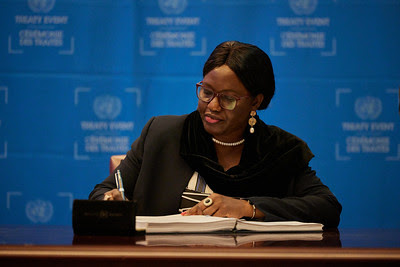
The Treaty on the Prohibition of Nuclear Weapons (TPNW) gained three new states - Indonesia, Sierra Leone and the Solomon Islands - as states parties during the UN General Assembly High-Level Week’s annual Treaty event from 24-27 September, the only treaty on nuclear weapons to do so. Indonesia becomes the TPNW’s largest state party by population, with a population of more than 284 million people. Speaking to the ratification of the Solomon Islands, Maverick Peter Seda from the Malaita Provincial Youth Council, an ICAN partner organisation in the Solomon Islands, and Reverse the Trend, a youth initiative of the Nuclear Age Peace Foundation said: “This is amazing news for all the young people in the Solomon Islands who have worked tirelessly to promote this outcome. We are committed to the goal of a nuclear-free Pacific and world.”
States parties and civil society also recently began new initiatives to get additional countries on board. On 6 September, in Addis Ababa in Ethiopia, the International Committee of the Red Cross, ICAN and South Africa co-hosted the African Conference on the Universalisation and Implementation of the TPNW for permanent representatives and experts of African Union member states, representatives of international organisations, scientific and civil society to take stock of the treaty from a regional perspective and advocate the need for further progress in universalising the treaty in Africa. In Switzerland, in July, the Swiss Alliance for the Prohibition of Nuclear Weapons launched a federal popular initiative to gather the 100,000 signatures needed from the Swiss public within 18 months to trigger a popular vote on joining the United Nations Treaty on the Prohibition of Nuclear Weapons (TPNW).
States parties to the TPNW continued actively on implementation work, with the next Meeting of States Parties scheduled to take place in less than six months, during the week of 3 March 2025 at the UN Headquarters in New York. Co-chairs of the working group on victim assistance, environmental remediation and international cooperation and assistance, Kiribati and Kazakhstan, convened consultations with individuals affected by nuclear weapons use and testing about the proposal to create an international trust fund for this work. The first consultation was with representatives of the hibakusha, who survived the bombings of Hiroshima and Nagasaki, held in late May. The second was held with representatives of countries in the Pacific affected by nuclear weapons testing, with speakers from Australia, Fiji, Kiribati and Maoui Nui/French Polynesia in late September. Meanwhile, TPNW states parties met in June, July and September to discuss their security concerns related to nuclear risks, and nuclear deterrence policies, with expert presentations.
 Indonesia, Sierra Leone and the Solomon Islands join the TPNW during High-Level Week at the UN in September. Photo: ICAN Indonesia, Sierra Leone and the Solomon Islands join the TPNW during High-Level Week at the UN in September. Photo: ICAN
|
|
Nuclear-armed states continue to prepare to use nuclear weapons
As long as nuclear weapons exist, so does the risk of their use, aggravated by nuclear-armed states' ongoing preparations to do so. NATO and Russian officials have both made recent public comments intended to indicate an increasing reliance on nuclear weapons. In an interview in June, then NATO Secretary-General Jens Stoltenberg said that NATO was in talks to deploy more nuclear weapons. In September, Russian President Vladimir Putin announced a change to Russian nuclear doctrine to consider nuclear responses to attacks by non-nuclear governments that have the support of nuclear-armed states. Nuclear-armed governments continue to test nuclear-capable missiles to ensure that they are prepared to be used. In September, China carried out its first publicly announced ICBM test in decades, and in the same week, a Russian ICBM test exploded in its silo and the United States tested two ICBMs in June. They also engage in military exercises to practice using nuclear weapons. The French Air Force exercises using nuclear weapons four times a year, and the third exercise was in September while the annual joint NATO exercise to practice launching nuclear weapons, Steadfast Noon, took place in October.

Former NATO Secretary- General Jens Stoltenberg. Photo: NATO.
|
From the Summit of the Future to the UN General Assembly: states meet to discuss disarmament
 Naomi Zoka addresses the Nuclear Non- Proliferation Treaty Preparatory Committee. Photo: ICAN Naomi Zoka addresses the Nuclear Non- Proliferation Treaty Preparatory Committee. Photo: ICAN
From July to September, there were a number of multilateral meetings addressing nuclear disarmament, with varying outcomes. The Summit for the Future took place on 22-23 September, and the Pact for the Future document was adopted. On nuclear disarmament the Pact includes Action 25: “We will advance the goal of a world free of nuclear weapons” and Action 26 “We will uphold our disarmament obligations and commitments.” While the actions reaffirm existing commitments, they do not add any new obligations. Nuclear-armed states and nuclear complicit states have shown little respect for their promises to adhere to these commitments, underscoring the need for the Treaty on the Prohibition of Nuclear Weapons as a new tool for nuclear disarmament.
All through the UN General Assembly High-Level Week from 23-27 September, state leaders expressed their concern about nuclear weapons. Brazil’s President Luiz Inácio Lula da Silva referenced the egregious spending on nuclear weapons and how those more than 90 billion dollars could have been used to combat hunger and climate change. The President of the General Assembly’s 79th session, H. E. Philemon Yang, in his address to the First Committee said “I call on those states which have not yet acceded to the Treaty on the Prohibition of Nuclear Weapons to do so without delay.”
The second Preparatory Committee of the Nuclear Non-Proliferation Treaty was held over two weeks in July-August 2024 and did not result in a consensus outcome document. Throughout the NPT Preparatory Committee, civil society and states spoke up against the refusal of nuclear weapons states to disarm, contrary to professed democratic values. ICAN’s statement was delivered by Naomi Zoka, who lives in Belgium, where U.S. nuclear weapons are stationed, and she stated that:
“Nuclear weapons deployed in Europe are designed to be used in Europe. But the consequences will not stay on this continent- and this continued deployment is decreasing security for others. … As citizens in the countries hosting nuclear weapons, we have repeatedly called for the bombs to be removed, but our governments claim they cannot discuss the issue- that it is not something they can confirm or deny. It seems that governments who support the use of nuclear weapons on their behalf believe in just enough transparency to make nuclear threats credible, but not enough transparency to enable effective democracy."
In August, the government of Kazakhstan invited representatives of the nuclear-weapon-free zones to Astana to meet to discuss collaboration amongst the zones. ICAN hosted a side event to share views on how the nuclear-weapon-free zones and the TPNW can strengthen each other. Melissa Parke, ICAN’s Executive Director, delivered a speech to the conference, highlighting the importance of this work being led by nuclear affected states, and challenging the idea that nuclear weapons are “normal”: “I sometimes hear members of the public say, ignorantly, that we need nuclear weapons because everyone else has them. They seem to believe that possessing nuclear weapons is the norm, when in fact just nine out of almost 200 countries in the world have them. Being a part of a nuclear-weapon-free zone is the norm.”
|
|
NEW RESOURCES
- Conference: Africans Against The Bomb, 25-26 September 2024: conference recordings; conference website
- Free online course: Banning the bomb: a global history of activism against nuclear weapons, The Open University, 25 September 2024
- Briefing Paper: Israeli Nuclear Weapons: Risks, Consequences and Disarmament, ICAN, September 2024
- Report: The Impact of Nuclear Weapons on Children, ICAN, August 2024
- Report: ‘Petrobromance’, Nuclear Priesthood, & Police Repression: Feminist Confrontations of Violent Industries and Movements to Abolish Them, Women’s International League for Peace and Freedom, July 2024
- Report: Nuclear Weapons Ban Monitor 2023, Norwegian People’s Aid, July 2024
|
|
Not signed up to receive our Policy & Research Newsletter yet?
|
|
|