Calls for increased nuclear reliance in Europe defy public opposition
|
|
|
TREATY STATUS
73 States Parties
94 signatories
|
|
RECENT NEWS
European leaders embrace nuclear weapons, despite popular opposition
In March, several European political leaders embraced an expanded role for nuclear weapons in their security doctrines, while a top South Korean official expressed an openness to acquire nuclear weapons, in open defiance of the Nuclear Non-Proliferation Treaty and without regard for the increased nuclear risk such actions would provoke nor for European domestic support for nuclear disarmament.
On 5 March, French President Macron said he had “decided to open the strategic debate on the protection of our allies on the European continent through our (nuclear) deterrence.” While the offer itself is not new, the reaction from several European leaders is. German Chancellor-to-be Friedrich Merz called for an expansion of French and British nuclear cooperation. Germany already hosts approximately 20 U.S. nuclear bombs, and trains its pilots in their delivery. “Nuclear sharing,” as this arrangement is commonly referred to, is unpopular domestically and widely condemned internationally.
Belgian Prime Minister Bart de Wever added his voice, suggesting the need for a pan-European “nuclear umbrella.“ Polish President Andrzej Duda, in an interview with the Financial Times, reiterated his call for Washington to deploy nuclear weapons in Poland. Both the Finnish Prime Minister and the Chair of the Defence Committee of the Finnish Parliament have welcomed the possibility of an expanded role for French nuclear weapons in Europe. Lithuanian Defense Minister Dovile Sakaliene said : "We believe we need to look into the possibility of adjusting Article 137 of the Constitution of the Republic of Lithuania if our allies propose realistic plans for the deployment of nuclear weapons or their components in Lithuania, and also to review other commitments," during a press conference at the Military Academy. Currently, the Lithuanian constitution prohibits the deployment of any weapons of mass destruction or foreign military bases on Lithuanian soil.
Public opinion stands in stark contrast with these statements, reflecting the anti-democratic nature of nuclear policy making. According to a 2021 poll, 83% of Germans, and 57% of Belgians want U.S. nuclear weapons stationed on their territory to be removed. An updated March 2025 poll still showed very little appetite in Germany for nuclear weapons. Major European cities, from Paris to Helsinki, have called on their governments to join the Treaty on the Prohibition of Nuclear Weapons (TPNW). A joint statement by ICAN European campaigners to the TPNW Third Meeting of States Parties and editorials in Germany, France and Finland, among others, underscore this popular opposition.
The Nuclear Non-Proliferation Treaty (NPT) prohibits nuclear-weapon states to transfer nuclear weapons or control over such weapons and to assist, encourage, or induce any non-nuclear-weapon State to manufacture or acquire nuclear weapons or to have control over such weapons (Article I). Article II further stipulates that non-nuclear-weapon states will not receive the transfer of nuclear weapons or of control over such weapons directly, or indirectly; and not to manufacture or otherwise acquire nuclear weapons or other nuclear explosive devices; and not to seek or receive any assistance in the manufacture of nuclear weapons or other nuclear explosive devices. The next meeting of NPT states parties, the last Preparatory Committee meeting ahead of the next Review Conference in 2026, will take place 27 April-8 May at the UN Headquarters in New York.
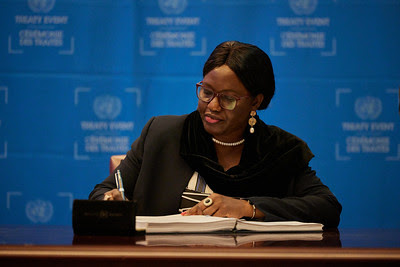
 Photo: Dan Meyers Photo: Dan Meyers
|
TPNW 3MSP concludes with successful outcome and inclusive process
The TPNW Third Meeting of States Parties concluded on 7 March with the adoption of a powerful political declaration and decisions to take forward the intersessional work. 86 countries participated in the meeting, alongside several international organisations and agencies, including the International Atomic Energy Agency, the Comprehensive Test Ban Treaty Organization, nuclear-weapon-free-zone secretariats and over one thousand individuals from 163 civil society organisations.
Amongst civil society, those affected by nuclear weapon impacts were active and integral participants. The Meeting heard expertise and policy recommendations from affected individuals from the Yankunytjatjara People, Kazakhstan, the Republic of Korea, Japan, the Marshall Islands, Maohi Nui (French Polynesia), Kiribati, Fiji and the Navajo Nation, among others.
The meeting’s political declaration resolutely condemned nuclear weapons and deterrence policies, stating that: “nuclear weapons are a threat to the security, and ultimately the existence, of all states, irrespective of whether they possess nuclear weapons, subscribe to nuclear deterrence or firmly oppose it” and that “Nuclear deterrence is posited on the very existence of nuclear risk, which threatens the survival of all.”
A report submitted to the conference provided detailed recommendations on how TPNW states can raise the threat that nuclear weapons pose to their security, including at the UN Security Council, with media and bilaterally with nuclear-armed states. 22 parliamentarians from 13 countries, including from nuclear-armed and allied countries, participated in a conference during the Third Meeting of States Parties, resolving to push for ratification of the TPNW in their respective legislatures.
The TPNW’s first Review Conference will be held at UN Headquarters in New York in November-December 2026, with South Africa serving as president.
 Photo: Darren Ortiz l ICAN Photo: Darren Ortiz l ICAN
|
UN votes to study nuclear war impacts and new research reveals drop in financial institutions backing nuclear weapons
In December 2024, the UN General Assembly First Committee voted to establish a 21-member scientific panel to produce a report on the impacts of nuclear war, the first UN study of its kind since 1989. Only France, the Russian Federation and the United Kingdom voted against the resolution to establish the panel, with the vast majority of states (144) voting in support.
The UN-mandated panel is tasked with “examining the physical effects and societal consequences of a nuclear war on a local, regional and planetary scale, including, inter alia, the climatic, environmental and radiological effects, and their impacts on public health, global socioeconomic systems, agriculture and ecosystems, in the days, weeks and decades following a nuclear war” and publishing a comprehensive report in 2027. A call for nominations of scientists for the panel was issued in February.
Meanwhile, the latest Don’t Bank on the Bomb report, At Great Cost: The companies building nuclear weapons and their financiers, launched in February, shows the number of financial institutions backing the nuclear weapons industry has dropped by a quarter since the TPNW entered into force in 2021. A group of 131 institutional investors, representing over four trillion US dollars in assets under management, have expressed support for the Treaty, including through the ICAN- Etica SGR Nuclear Weapons Free Finance Initiative.
The top companies profiting from nuclear weapons contracts are Northrop Grumman, General Dynamics, BAE Systems, Boeing, Leonardo, Lockheed Martin and RTX. During the period covered by this report, just under $270 billion was provided to the 24 nuclear weapon producing companies in loans and underwriting, a drop of $6.2 billion since the previous report. The biggest lenders are Bank of America, Citigroup, JP Morgan Chase. However, share and bond values increased, with investors holding $513.6 billion in shares and bonds, an increase of $36.7 billion. The top shareholders are Vanguard, Capital Group, and Blackrock.

|
|
Doomsday Clock set at 89 seconds to midnight
With the Bulletin of the Atomic Scientists’ Doomsday Clock the closest it has ever been to midnight, U.S. President Trump expressed interest in discussing denuclearisation with China and Russia and reducing nuclear weapons spending. The Doomsday Clock was reset in January 2025 to 89 seconds to midnight, due to the failure to reverse major crises such as climate change and the increased risk of nuclear weapons. In presenting the new time, former Colombian President Juan Manuel Santos also highlighted the importance of the TPNW.
In its statement, the Bulletin emphasised the increased risk of nuclear weapons use, the threat of climate change and the unchecked rise of artificial intelligence among the key reasons for the Clock’s change, as well as the interrelations between these three threats and the urgency to tackle them at the same time.
In February, U.S. President Trump expressed concern about the threat posed by nuclear weapons and their cost and his interest in pursuing denuclearisation. "There's no reason for us to be building brand-new nuclear weapons. We already have so many, you could destroy the world 50 times over, 100 times over. And here we are building new nuclear weapons. And they're building new nuclear weapons. And China's trying to catch up," he said. According to ICAN research, nuclear-armed state spending has increased by 34% in the last five years. However, cuts to Department of Defense spending ordered in late February explicitly excluded nuclear weapon spending and Trump has since proposed the construction of a criticised and enormously costly missile defense program.

Photo: Bulletin of the Atomic Scientists.
|
NEW RESOURCES
-
ICAN, “What is the “Eurobomb” and why are European politicians talking about it?” March 2025
-
ICAN, “Five myths on nuclear deterrence”, March 2025
- Norwegian People’s Aid, "Nuclear Weapons Ban Monitor 2024," March 2025
-
ICAN and Don’t Bank on the Bomb, “At Great Cost: The companies building nuclear weapons and their financiers”, February 2025
- Setsuko Thurlow, “Dear prime minister, please address the nuclear threat to life on Earth: from a Hiroshima survivor”, The Hill Times, 20 February 2025
|
|
Not signed up to receive our Policy & Research Newsletter yet?
|
|
|