Malta has signed and ratified the Treaty on the Prohibition of Nuclear Weapons (TPNW). It was among the original 50 states parties to the treaty when it entered into force on 22 January 2021.
Signature and ratification
Vanessa Frazier, the then-permanent representative of Malta to the United Nations, signed the TPNW in New York on 25 August 2020, and Malta deposited its instrument of ratification with the UN secretary-general on 21 September 2020.
The foreign ministry said that its signature of “this important treaty continues to underscore Malta’s unwavering commitment towards nuclear non-proliferation, and highlights its commitment towards achieving prosperity through peace”.
Ambassador Vanessa Frazier of Malta signs the TPNW in 2020. Photo: Malta MFA
Malta’s ratification of the TPNW coincided with a high-level meeting of the UN General Assembly to commemorate the 75th anniversary of the United Nations. It also coincided with Malta’s independence day.
The foreign ministry said that the goal a world free of nuclear weapons is “a guiding principle of Malta’s foreign policy”, and its ratification of the TPNW is testament to its commitment to global disarmament, which is “crucial to securing a safer future for all and for future generations”.
Malta was the 45th state to ratify or accede to the treaty.
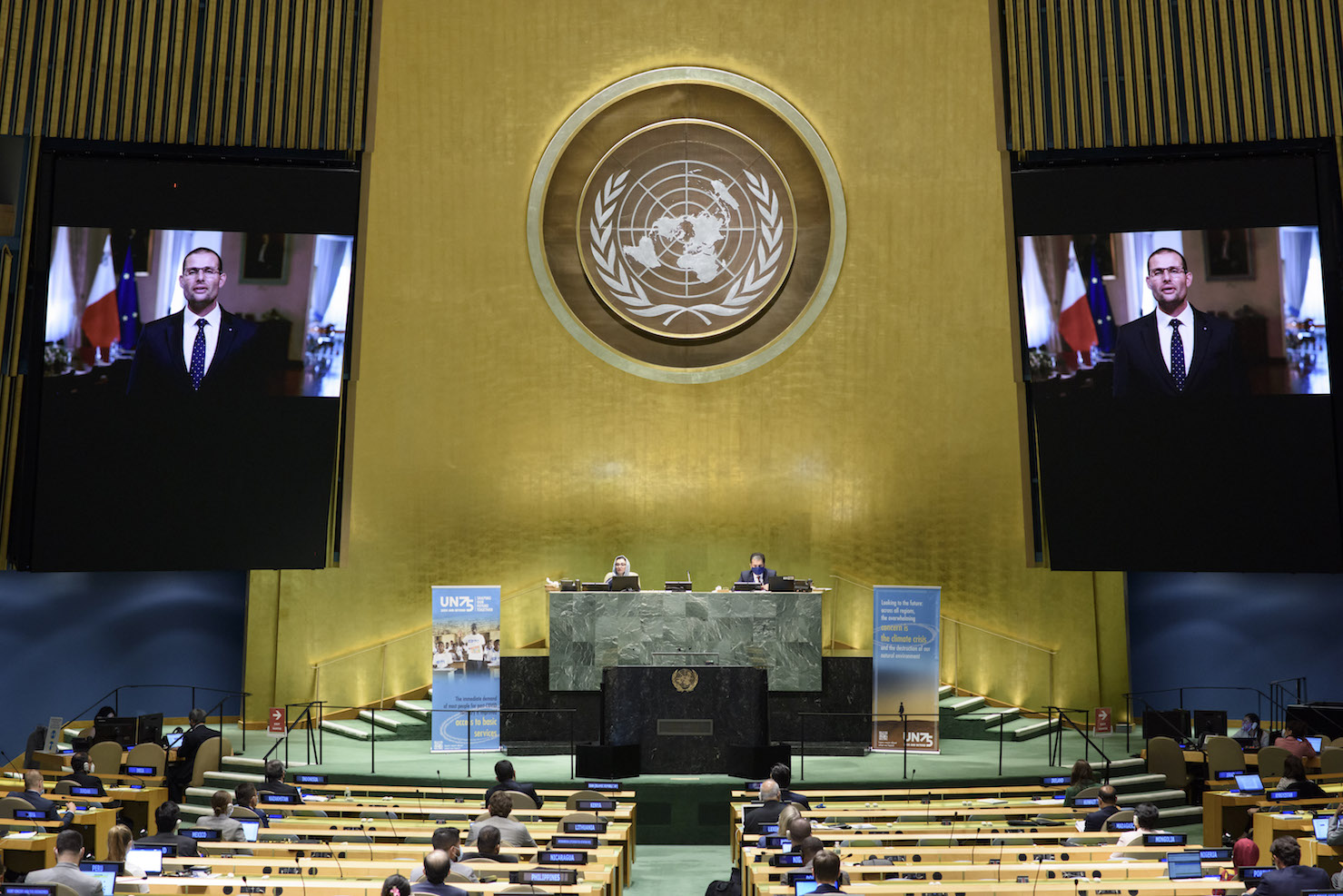
Malta’s prime minister, Robert Abela, addresses the UN General Assembly on 21 September 2020, the day of his country’s ratification. Photo: UN Photo
National position
In 2021, the then-minister of foreign affairs of Malta, Evarist Bartolo, said that the TPNW had “strengthened the global norm against the worst weapons of mass destruction”, and it is “our duty to promote the benefits of such treaty, help fight misconceptions about it, and ensure that its obligations are adhered to”.
Addressing the UN General Assembly, Bartolo urged all states “to accede to this important treaty, which would send a strong political signal against the production, stockpiling, and use of nuclear weapons”. It could also “create the necessary momentum to embark on serious disarmament talks, which have been stalled for too long”, he said.
In 2022, Malta said that it felt encouraged by the TPNW’s entry into force. “We strongly believe in the benefits of this humanitarian-led initiative – which complements the [Non-Proliferation Treaty of 1968],” it said. “The TPNW strengthens the global norm against these weapons and fills a legal gap as the first outright prohibition on nuclear weapons.”
Implementation
In accordance with Article 2 of the TPNW, Malta submitted a declaration to the UN secretary-general on 27 January 2021 confirming that it does not own, possess, or control nuclear weapons, has never done so, and does not host any other state’s nuclear weapons on its territory.
As required by Article 3, Malta has a comprehensive safeguards agreement in force with the International Atomic Energy Agency to guard against the misuse of nuclear facilities and materials. It also has an additional protocol in force.
Per Article 12, Malta has promoted universal adherence to the TPNW, including by co-sponsoring and consistently voting in favour of an annual UN General Assembly resolution since 2018 that calls upon all states to sign, ratify, or accede to the treaty “at the earliest possible date”.
In 2024, Malta pledged to continue advocating for the TPNW’s universalisation “with the goal of creating momentum to revive international disarmament talks”.
Meetings of states parties
Malta participated in the first meeting of states parties to the TPNW in 2022. It noted that the “current bleak geopolitical situation has created an even greater sense of urgency” in moving forward with “concrete actions to implement our obligations under the TPNW”.
It also participated in the second meeting of states parties in 2023 and the third meeting in 2025.
TPNW negotiations
Malta participated in the negotiation of the TPNW at the United Nations in New York in 2017 and was among 122 states that voted in favour of its adoption.
In 2016, Malta co-sponsored the UN General Assembly resolution that established the formal mandate for states to commence negotiations on “a legally binding instrument to prohibit nuclear weapons, leading towards their total elimination”.
Before the negotiations
Malta was among 127 states that endorsed a “humanitarian pledge” in 2015–16 to cooperate “in efforts to stigmatise, prohibit, and eliminate nuclear weapons”. The pledge was instrumental in building momentum and support for convening the TPNW negotiations.




 Malta
Malta