Timor-Leste has signed and ratified the Treaty on the Prohibition of Nuclear Weapons (TPNW), and has been legally bound by it since 18 September 2022.
Signature and ratification
Dionisio Da Costa Babo Soares, the then-minister of foreign affairs of Timor-Leste, signed the TPNW at a high-level ceremony in New York on 26 September 2018.
On 25 April 2022, the national parliament of Timor-Leste adopted a draft resolution with unanimous support to ratify the TPNW. Speaking in support of the resolution, Adaljíza Magno, the then-minister of foreign affairs, said: “We know the consequence of the Hiroshima and Nagasaki bombings and we don’t want the world to experience the same thing.”
José Agostinho Sequeira, the president of the parliamentary committee on security, defence and foreign affairs, hailed it as a significant move in the campaign to abolish nuclear weapons.
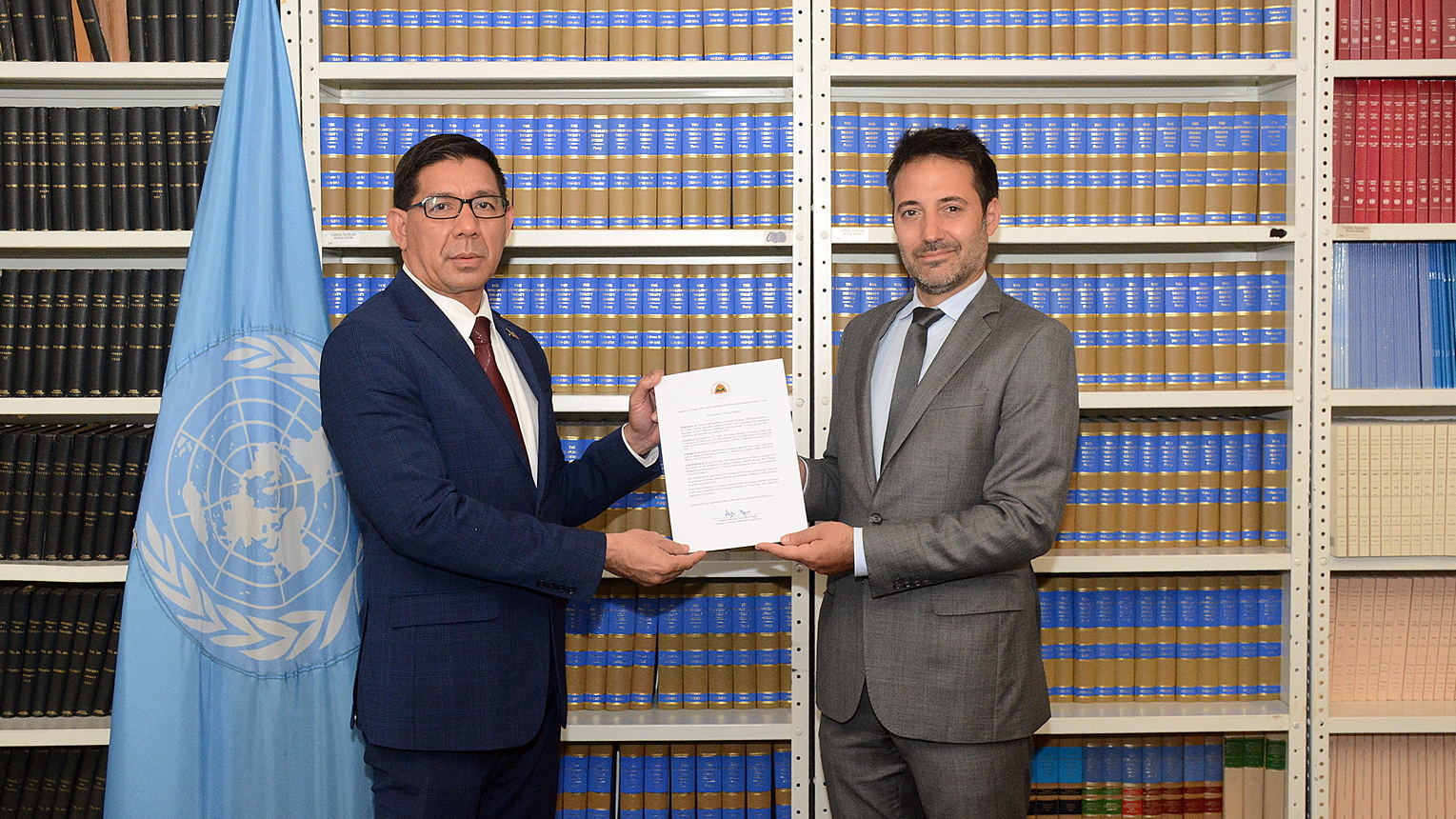
Timor-Leste deposited its instrument of ratification with the UN secretary-general on 20 June 2022, one day before the first meeting of states parties to the treaty, becoming the equal 63rd state party.
Timor-Leste has described its ratification of the TPNW as a reflection of its “commitment to a culture of peace and disarmament”.
Dionisio Da Costa Babo Soares, the then-minister of foreign affairs of Timor-Leste, signs the TPNW in 2018. Photo: ICAN
Ambassador Karlito Nunes deposits Timor-Leste’s instrument of ratification in 2022. Photo: UNOLA
National position
In 2021, Timor-Leste hailed the TPNW’s entry into force as “an extraordinary achievement and a step towards the eventual elimination of nuclear weapons”. It views the treaty “as an important international norm for peace, our collective security, and preservation of human life”.
In 2024, Timor-Leste noted that the TPNW “aims to close the existing legal gap on nuclear disarmament”, complementing the Non-Proliferation Treaty of 1968 “in achieving humanity’s common goal of eliminating nuclear weapons”.
Implementation
In accordance with Article 2 of the TPNW, Timor-Leste submitted a declaration to the UN secretary-general on 17 March 2023 confirming that it does not own, possess, or control nuclear weapons, has never done so, and does not host any other state’s nuclear weapons on its territory.
On 25 September 2024, Timor-Leste brought into force a comprehensive safeguards agreement with the International Atomic Energy Agency to guard against the misuse of nuclear facilities and materials, as required by Article 3. It also brought into force an additional protocol at the same time.
Per Article 12, Timor-Leste has promoted universal adherence to the TPNW, including by co-sponsoring and consistently voting in favour of an annual UN General Assembly resolution since 2018 that calls upon all states to sign, ratify, or accede to the treaty “at the earliest possible date”.
In 2024, the prime minister of Timor-Leste, Xanana Gusmão, called on “everyone to contribute to ensuring our common future”, including by ratifying the TPNW.
Meetings of states parties
Timor-Leste observed the first meeting of states parties to the TPNW in 2022. (Although it had ratified the treaty one day before the meeting, it was considered an observer, as the treaty had not yet entered into force for it.)
Adaljiza Magno, the then-minister of foreign affairs, said at the meeting that Timor-Leste “continues to believe in the power of peaceful dialogue and constructive role played by all states to promote a conducive atmosphere for a peaceful denuclearisation of the world”.
Timor-Leste participated in the second meeting of states parties in 2023 and the third meeting in 2025.
TPNW negotiations
Timor-Leste participated in the negotiation of the TPNW at the United Nations in New York in 2017 and was among 122 states that voted in favour of its adoption.
In 2016, Timor-Leste voted in favour of the UN General Assembly resolution that established the formal mandate for states to commence negotiations on “a legally binding instrument to prohibit nuclear weapons, leading towards their total elimination”.
Before the negotiations
Timor-Leste was among 127 states that endorsed a “humanitarian pledge” in 2015–16 to cooperate “in efforts to stigmatise, prohibit, and eliminate nuclear weapons”. The pledge was instrumental in building momentum and support for convening the TPNW negotiations.




 Timor-Leste