Policy and Research Newsletter no. 26
As the 81st UNGA First Committee concludes, nuclear risks continue to rise
|
|
|
TREATY STATUS
75 States Parties
26 signatories
|
|
RECENT NEWS
States condemn rising nuclear risks at UN annual meeting on disarmament
At the UN General Assembly First Committee on Disarmament, which kicked off this year on 5 October, governments expressed concern about rising nuclear risks, an increased reliance on nuclear weapons, nuclear sharing arrangements, nuclear threats, the prospect of artificial intelligence being integrated into nuclear weapons systems, and the expiration of New START. At least 52 states, and seven groups (the African Group, ASEAN, CELAC, CARICOM, NAC, NAM and TPNW States Parties) referenced the Treaty on the Prohibition of Nuclear Weapons (TPNW), and 123 states voted in favor of the annual resolution on the TPNW. For more coverage of the First Committee debates, read Reaching Critical Will’s First Committee Monitor. Just before the start of the First Committee, presidents and foreign ministers addressed the high-level plenary meeting on the International Day for the Total Elimination of Nuclear Weapons on 29 September, along ICAN Executive Director Melissa Parke who called out the damaging behavior of the nine nuclear-armed states and urged that all states sign and ratify the TPNW.

Ronald Ozzy Lamola, South African Minister for International Relations and Cooperation addresses the UN General Assembly. Photo: UN Photo.
|
TPNW Review Conference approaches with goal to review implementation, expand membership
From 30 November - 4 December, TPNW States Parties will meet for their first Review Conference, to assess implementation of the Treaty and the 50-point Vienna Action Plan, adopted at the First Meeting of States Parties in 2022. South Africa, on behalf of TPNW States Parties, told the UN General Assembly First Committee: “We will use the First Review Conference of the Treaty to strengthen implementation, deepen cooperation and widen participation. A world free of nuclear weapons, is a global public good of the highest order, and we invite all States to join us in achieving it.” The timetable for the Review Conference and advance versions of some intersessional working group reports are available on the UN Office for Disarmament Affairs website for the Review Conference. Information for civil society, including on ICAN’s Nuclear Ban Forum, on the 29th of November, is available on ICAN’s website.

|
Governments and civil society mark 35th anniversary of Kazakhstan test site closure, call for justice for survivors
In August, commemorations for the International Day Against Nuclear Tests were held at the UN headquarters, and in Semey, Kazakhstan. In Semey on 28-29 August, the Public Association “DOM” and the Qazaq Nuclear Frontline Coalition (QNFC / ASQAQ) organized a series of events, including a testimony meeting with survivors from Kazakhstan and beyond, film screenings, and an International Civil Society Forum for Peace to mark the International Day Against Nuclear Tests and the 35th anniversary of the closure of the Semipalatinsk Test Site. The Forum concluded with the adoption of the Semey Peace Declaration, articulating priorities for addressing nuclear testing consequences.
The following week in New York, on 1 September, 20 governments, including Japan, Kazakhstan, Kiribati and the Marshall Islands, and civil society representatives, spoke at the UN General Assembly-mandated international meeting on victim assistance and environmental remediation, highlighting their efforts thus far, and proposing new policy solutions.

Kazakhstan co-chairs the International Meeting on Victim Assistance and Environmental Remediation. Photo: UN photo by Manuel Elias
|
Nuclear-allied states deepen reliance on nuclear weapons
While some governments and civil society gathered at the United Nations and elsewhere to condemn nuclear weapons, nuclear-armed states and those in nuclear alliances continued their ongoing preparations for, and threats of, nuclear use. Seventeen NATO countries practiced using nuclear weapons in Europe in annual exercises called Steadfast Noon, from 13-23 October, and the U.S. carried out its own nuclear exercises on 22 October. At the same time, the Norwegian Pension Fund Global moved one step closer to investing in nuclear-weapon producing companies. A committee presented a report to the Finance Minister, and former NATO Secretary-General, Jens Stoltenberg, on 15 October recommending allowing the Fund to invest in nuclear weapon producing companies in France, the United Kingdom and the United States. The recommendation is open for public comment until 15 January 2027, after which, it will go to Parliament, which rejected a similar proposal in 2025.

Svein Gjedrem and Jens Stoltenberg presenting the report on the Norwegian Pension Fund Global. Photo: Ida Laingen/Norwegian Ministry of Finance.
|
Nuclear-armed states test nuclear-capable missiles, make nuclear threats, spark proliferation concerns
North Korea and France both conducted nuclear-capable, submarine-launched missile tests in October, and China launched such a missile in July. India fired off a nuclear-capable intercontinental ballistic missile test on the 81st anniversary of the U.S. dropping a nuclear weapon on Hiroshima on 6 August. The United States is reportedly working towards a policy change to emphasize the option to use so-called “tactical” nuclear weapons in its guidance on using nuclear weapons.
Nuclear-armed states have made several nuclear threats recently, including Moscow warning on 29 September that it is prepared to use "the entire arsenal… including nuclear weapons" if NATO countries attempt to isolate the Russian exclave of Kaliningrad. U.S. President Trump used the pulpit of the United Nations General Assembly to threaten to “annihilate” Iran on 22 September.

Donald Trump, U.S. President, threatens to annihilate Iran at the UN General Assembly. Photo: UN Photo.
The United States has yet to come to an agreement with Iran regarding its nuclear programme, and Iran has not fully cooperated with the International Atomic Energy Agency (IAEA) since Israel and the United States bombed Iran last June. In September, the IAEA reported Iran to the UN Security Council for its non-cooperation. There is no indication that Iran is working to weaponise its nuclear materials. The agreement signed in July for the United States to sell uranium enrichment technology to Saudi Arabia, which raised numerous proliferation concerns, can still be stopped by Congressional action.
|
|
Support for TPNW expressed by new cities, states, countries and polls
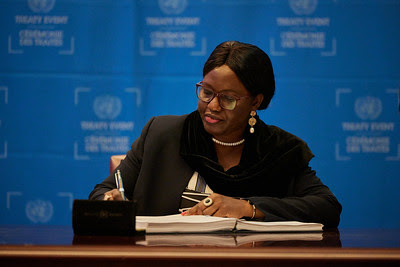
Despite these dangerous actions by nuclear-armed leaders, others are working to promote a nuclear-free world. And even in the most difficult security conditions, nuclear disarmament is possible. This October marked forty years since, at the height of the Cold War, the leaders of the Soviet Union and the United States nearly negotiated the elimination of their nuclear arsenals. In recent months, Gabon signed and Tonga ratified the TPNW, and Tonga ratified the CTBT at the same time. A resolution was introduced to Parliament in Spain in September, calling for Madrid to join the TPNW. While the resolution was ultimately defeated, a recent poll found that 80% of Spaniards want their government to join. Another recent poll found that Swedes overwhelmingly support joining the Treaty and reject hosting nuclear weapons. In the month of August alone, a new Italian municipality (Cosenza), three additional Spanish cities (Monresa, Gandia and Cerdanyola del Vallès) and a new U.S. state (Massachusetts) expressed their support for the TPNW. Fiji hosted a Pacific dialogue on nuclear justice and nuclear disarmament, including on TPNW Articles 6 and 7 on victim assistance, environmental remediation and international cooperation and assistance, on 28-30 October.
 Participants of the Pacific dialogue on nuclear justice and nuclear disarmament in Fiji. Photo: Mere Tuilau.
|
|