Policy and Research Newsletter no. 24
With nuclear spending surpassing $100 billion, US & Israel bomb Iranian nuclear facilities
|
|
|
TREATY STATUS
73 States Parties
94 signatories
|
|
RECENT NEWS
Nuclear-armed state spending on nuclear weapons continues to rise, against public opinion
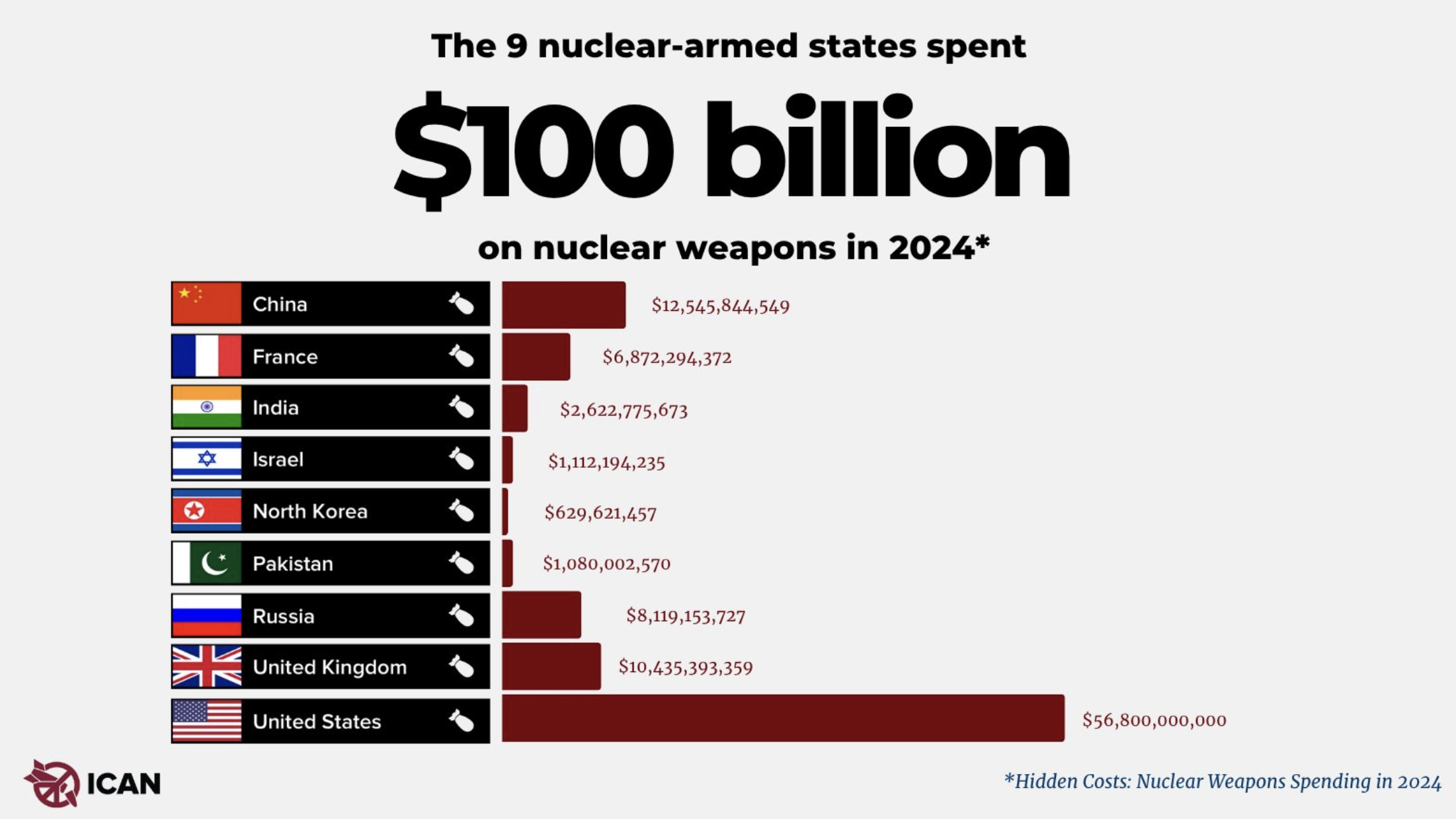
In 2024, nuclear-armed states spent over $100 billion on nuclear weapons as ICAN revealed in our report: Hidden Costs: Nuclear Weapons Spending in 2024, released in June 2025. The nine nuclear-armed states spent $9.9 billion more on their nuclear arsenals than the previous year, which represents an increase of 11%. The US spent the most, with an increase of $5.3 billion from 2023 to 2024. In 2025, the Congressional Budget Office estimated that upgrades to the U.S. nuclear arsenal would cost $946 billion over 10 years. The report also highlights the role of companies play in nuclear weapons production. At least 26 companies generated a total of $43.5 billion in 2024 for nuclear weapons work and paid lobbyists in France and in the US $128 million to represent their interests.
This spending is due in large part to the ongoing efforts of nuclear-armed states to upgrade their arsenals, as documented in the 2025 SIPRI Yearbook, also released in June. Investing in nuclear arsenals undermines democracy, as it is conducted with very little public oversight and contradicts the demonstrated support for disarmament in many countries around the world. ICAN highlighted that for European countries hosting U.S. nuclear weapons, taxpayer costs to do so remain unknown. In June, Athens became the 12th capital to sign the ICAN Cities Appeal, joining hundreds of other cities around the world to pledge to work to get their government to join the Treaty on the Prohibition of Nuclear Weapons. Only nine countries in the world own nuclear weapons (less than 5% of UN members), in comparison with the 98 countries that have now joined the TPNW. Instead of being spent on nuclear weapons, the $100 billion allocated in 2024 could have addressed far more important global needs. This amount is eight times the United Nations’ annual budget and could have fed $345 million people facing severe hunger for nearly two years.
|
United States bombs Iran, in dangerous escalation that undermines nuclear non-proliferation
On 21 June, the United States attacked three Iranian nuclear sites: Esfahan, Natanz and Fordow, following Israeli strikes targeting Iranian nuclear facilities, including Natanz and Esfahan, and leading Iranian scientists the week before, in an illegal and dangerous escalation that undermines nuclear non-proliferation and international peace and security. As part of its response, Iran has passed a law ending its cooperation with International Atomic Energy Agency (IAEA) nuclear inspectors, and Iran also retaliated with missile strikes on the U.S. military base at Al Udeid Air in Qatar.
The Natanz facility includes two uranium enrichment complexes and an unnamed underground facility. The Fordow Facility is a uranium enrichment facility buried into a mountain side. The Esfahan facility processes natural uranium, fabricates nuclear fuel, and converts uranium into powder and metal. Satellite images confirm that Fordow was heavily damaged. Yet, due to the fact that it is buried deep underground, the full extent of the impact is still unclear. U.S. intelligence and the IAEA did not assess at the time of the strike that Iran was pursing nuclear weapons, and these facilities were all part of Iran's civilian nuclear energy program.
The attack followed five rounds of negotiations from April to June between the United States and Iran on the Iranian nuclear program in Oman and Italy. Israel abruptly ruptured negotiations when it struck Iran on 13 June. Many countries have condemned the Israeli and U.S. strikes as illegal. 20 Arabs and Islamic States released a joint statement stating the “necessity of refraining from targeting nuclear facilities that are under the safeguards of the International Atomic Energy Agency (IAEA)” and describing the U.S. and Israeli actions as a “blatant violation of international law and international humanitarian law.”
This conflict has shown that military strikes on nuclear facilities are not only dangerous and illegal but also ineffective. While the strikes did damage some of Iran’s nuclear infrastructure, they also made it impossible for international inspectors to track Iran’s stockpile of highly-enriched uranium, which may have been moved from its previous location, and Iran retains nuclear expertise.
Diplomatic agreements are the only viable path forward. Iran must remain party to the Non-Proliferation Treaty (NPT) and comply with its safeguards. At the same time, the Treaty on Prohibition of Nuclear Weapons presents a path to verifiably eliminate nuclear weapons. All countries should join. The Treaty bans the use, threats to use and possession of nuclear weapons and rejects the legitimacy of nuclear weapons entirely. In the wake of this current crisis, Colombia’s Parliament moved to ratify the TPNW, declaring that: “In an international context marked by the escalation of conflicts and the latent threat of the use of weapons of mass destruction, Colombia sends a clear message: peace is a non-negotiable principle, and disarmament is a moral imperative. This decision takes on even greater significance amid tensions in the Middle East, which underscore the need to strengthen multilateral mechanisms for prevention, control, and disarmament.”
|
|
Conflict between India and Pakistan raises threat of nuclear use
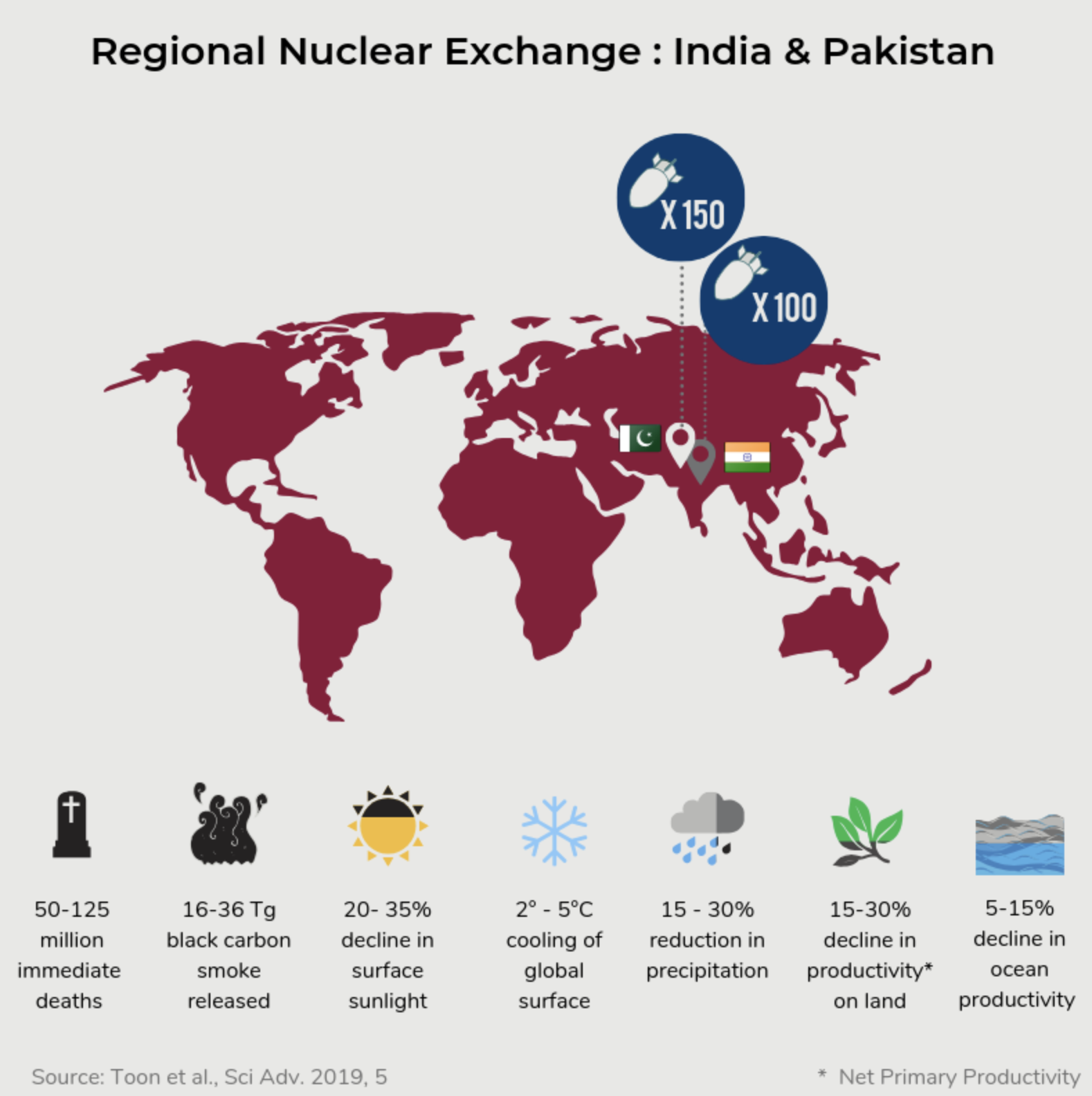
The ever-present threat of nuclear use was put into sharp relief as tensions escalated between India and Pakistan in April. On 22 April, a terrorist attack occured in Kashmir, a region disputed since the 1947 partition of India with territorial claims both from India and Pakistan. The attack took place in India-administered Kashmir and India immediately blamed Pakistan, responding with strikes near Pakistani’s army headquarters. Both countries are nuclear-armed: Pakistan owns approximately 170 nuclear weapons and India has an estimated 180. A ceasefire was announced on 10 May but this conflict shows the fragility of nuclear deterrence. The conflict exposed how unpredictable events can still bring nuclear-armed states dangerously close to war and does not prevent attacks on nuclear-armed countries.
|
|
|
French parliamentary inquiry report recommends reform in assistance to survivors of French nuclear detonations in Mā’ohi Nui as United States passes extension and expansion of Radiation Exposure Compensation Act
On 10 June, following a six-month parliamentary inquiry, the French National Assembly published a “Rapport d’enquête” examining France’s nuclear detonations in Mā’ohi Nui/French Polynesia between 1966 and 1996 and recommending reforms to French assistance to nuclear survivors. To this day, France has yet to fully acknowledge the full human and environmental toll of its nuclear detonations in Polynesia, and this parliamentary inquiry did not address France’s nuclear detonations in Algeria.
The report indicates that there is evidence of increased cancer rates among both veterans and the Polynesian population, attributed to radiation exposure, a situation exacerbated by inconsistent or insufficient safety protocols during the testing period. The “Morin Law,” which was enacted to compensate victims of radiation exposure, remains limited in its scope and effectiveness in addressing the needs of affected individuals and their families. As such, the report underscores the necessity of reforming the law “in the interests of efficiency, justice, and legitimate recognition”. Nuclear detonations also had a profound ecological impact, particularly on marine life and local food sources. Notably, the environmental damage began even before the detonations, as coral reefs were destroyed to facilitate the construction of platforms and testing infrastructure.The development of nuclear testing infrastructure across Polynesia also had far-reaching social, economic, and cultural implications. Prior to the establishment of the Centre d’Expérimentation du Pacifique (CEP), Polynesia’s economy was largely non-industrial and relied heavily on primary sectors such as fishing. The cessation of testing brought with it a significant economic downturn, marked by rising unemployment and growing budgetary deficits. The compensation mechanism known as the Comité d'indemnisation des victimes des essais nucléaires (CIVEN) was quickly constrained by the restrictive nature of its criteria and implementation procedures. CIVEN was widely perceived as opaque and overly bureaucratic, limiting its accessibility to those most in need.
In response to its assessment of the consequences of nuclear detonations in French Polynesia and the inadequacy of current assistance measures, the report produced 45 recommendations. These recommendations included important suggestions which, if enacted, would expand the number of impacted individuals eligible for compensation. Recommendation 14, for example, is to “eliminate the requirement for a millisievert threshold”, the current arbitrary threshold of radiation exposure required to receive compensation. Recommendation 8 suggests to “conduct research into the existence of transgenerational effects of exposure to ionizing radiation” and recommendation 17 calls for “open up the right to compensation for so-called ‘par ricochet’ victims.” This report is an important step forward towards recognising and addressing the many harms caused by French nuclear detonations. These recommendations should be implemented completely and urgently to address the long overdue needs of people and the environment harmed by nuclear detonations.
Meanwhile, on 3 July, the United States passed an extension and expansion of its legislation to compensate survivors of nuclear weapon detonations, nuclear workers and uranium miners in the United States, the Radiation Exposure Compensation Act, as part of a larger budget reconciliation bill. The bill extended the program through 2028 after it lapsed last year. It increased most compensation claims to $100,000 and expanded who could be compensated to include those who were located in Utah, New Mexico, Idaho and parts of Arizona and were “downwind” of U.S. nuclear detonations in New Mexico and Nevada. It also expanded coverage for uranium miners and, for the first time, also covered communities impacted by nuclear waste in parts of Missouri, Tennessee, Kentucky and Alaska. Notably it does not cover everyone impacted by nuclear weapons activities in the United States, let alone those harmed by U.S. nuclear detonations located outside of the United States. Downwinders in parts of Nevada, Arizona, Montana, Colorado and Guam and those impacted by nuclear waste in Ohio, Pennsylvania and Washington are among those in the United States still pressing for compensation.
|
|
UK moves to be able to drop U.S. nuclear warheads as NPT PrepCom concludes without outcome
On 3 June, the United Kingdom released its Strategic Defense Review, signalling an increased reliance on nuclear weapons in a direct contradiction to its obligations under the Nuclear Non-Proliferation Treaty to pursue disarmament. Specifically, the Strategic Defense Review recommended that the United Kingdom spend £15 billion on its nuclear warheads, and that the United Kingdom purchase F-35A bomber jets from the United States, which could be used to drop the U.S. nuclear warheads reportedly being moved to Britain. The report does not explicitly state that the UK would be enabled to drop U.S. warheads, but the purchase of F-35A planes, the same planes that other U.S. nuclear hosting countries in Europe have purchased for this purpose, and the report’s recommendation to “examine the potential benefits and feasibility of enhanced UK participation in NATO’s nuclear mission”, combined with the recent reported preparations to move U.S. nuclear warheads to Lakenheath Air Force base point in that direction.
This report was released just one month after the third Preparatory Committee (PrepCom) for the 2026 Review Conference of the Parties to the Treaty on the Non-Proliferation of Nuclear Weapons ended without producing consensus recommendations for the upcoming Review Conference. Differences emerging during the meeting included concerns about the security impact of ongoing nuclear deterrence policies on states not involved in those arrangements, the urgency of action to implement nuclear disarmament negotiations, and transfers of nuclear technology to states outside the treaty. There was also no agreement on ways and means to strengthen the NPT review process. Throughout the meeting, many states stressed not only the complementarity of the TPNW to the NPT, but also highlighted its crucial role in booking actual advances towards disarmament in these tense times. South Africa, which holds the presidency for the first TPNW Review Conference, stated: “the TPNW represents the highest non-proliferation standard that any State can commit to, thereby strengthening and complementing the NPT.”
|
|
RESOURCES
Publications, articles and other materials:
|
|
Not signed up to receive our Policy & Research Newsletter yet?
|
|
|