




SHARE




What if algorithms don't feel fear? Nuclear deterrence isn't a military capability. It's a means of communication, intimidating the opponent's mind, making them feel afraid. As AI edges into nuclear systems, it exposes the paradox at the heart of nuclear deterrence.
Artificial intelligence is changing how governments approach national security. It is reshaping intelligence analysis, early-warning systems, and military decision-making. Its growing role in the nuclear realm has sparked fears of a future in which machines decide to launch nuclear weapons.
That future is not here. No government or strategist is currently advocating that AI take charge of nuclear launch decisions. There is strong international agreement that these decisions must stay under human control.
But that misses the deeper issue. AI is already being woven into nuclear-related systems. AI is used in the military domain to identify missile launches, analyse sensor data, and model escalation. These integrations expose something that has always been true, nuclear deterrence has never been stable or responsible. The idea of responsible management of a genocidal capability, has always been an illusion. Nuclear deterrence relies on fear, perception, and moral contradiction. Increasing the speed of automation in these systems does not offer stability, it makes them more dangerous.
The Creeping Integration of AI
Currently AI applications are built to assist human decision-makers, not replace them. They filter data, flag threats, and support commanders under extreme time pressure. But even when humans keep final authority, automation reshapes how decisions get made. It determines what information appears, how it gets prioritised, and how fast a response is expected.
As reaction times shrink, the risk of catastrophic miscalculation grows. In a crisis, machine-generated assessments add urgency. Humans must respond to systems they cannot fully understand or verify in real time. As more nuclear-armed states fold AI into their command, control, and intelligence networks, the risk of unpredictable interactions between competing automated systems rises. These systems are also vulnerable to hacking and hallucinating and other interference.
AI magnifies the central weakness of deterrence, that it depends on fragile assumptions about rationality, perception, and control.
The Myth of Rational Control
For decades, nuclear deterrence has been sold as rational management, a balance of terror held steady by calculated threats. In reality, it is psychological theatre. It works by trying to shape an adversary's behaviour through fear and the threat of annihilation. The whole logic of deterrence lives in the human mind.
Artificial intelligence breaks that logic. Algorithms cannot be coerced, bluffed, or frightened into restraint. They can be manipulated, fed false data, deceived, or trained to fail. That is a serious problem in its own right. But it is a different problem. It is not the manipulation deterrence relies on: intimidating a population, or impressing a leader's mind, through shows of nuclear force. Code has no psyche. It cannot be impressed by posturing.
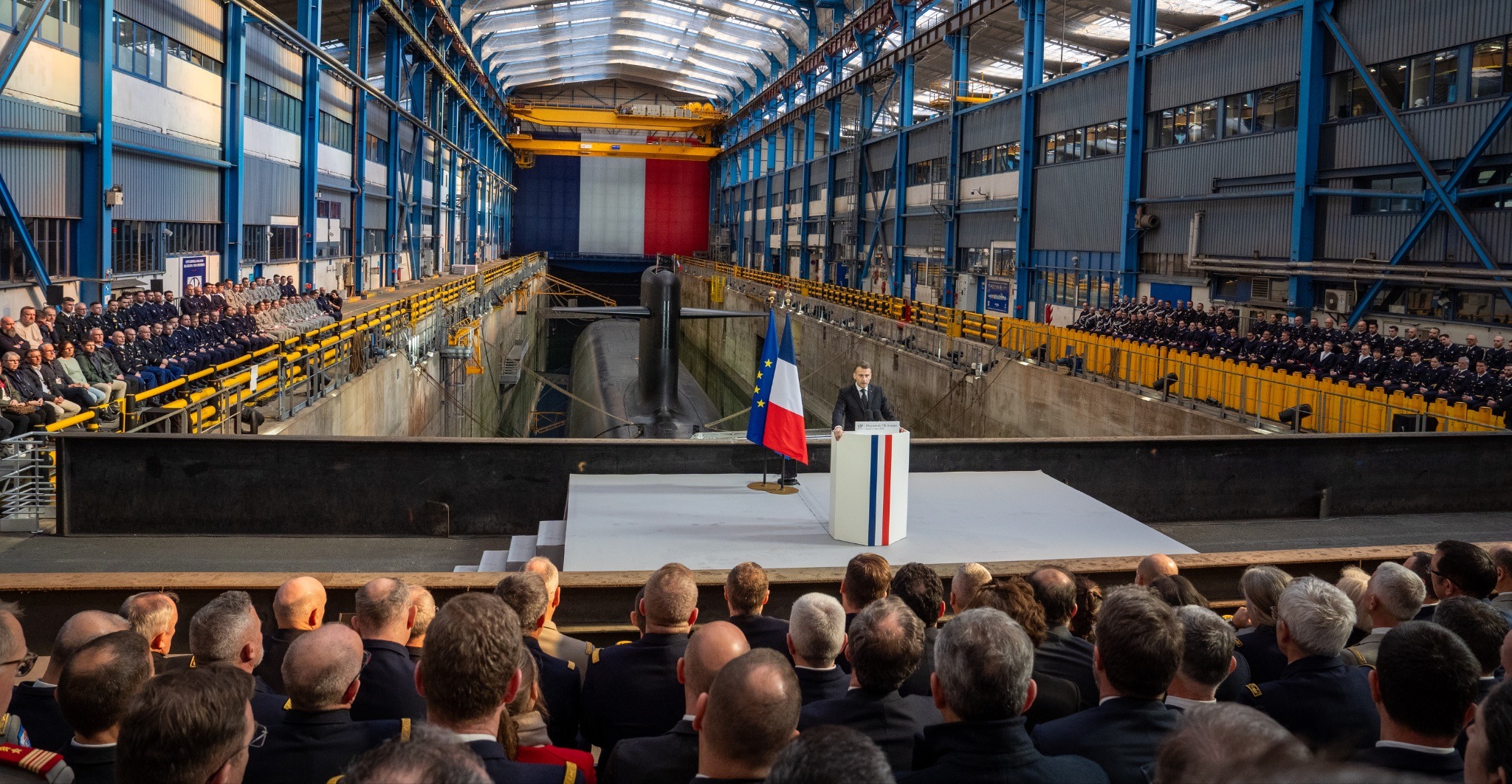
Would an Algorithm be impressed? French President Macron speaking about the French nuclear weapons modernisation programme in front of a nuclear-capable submarine in March 2026.
We are not yet in an era of fully automated nuclear decision-making. But the trajectory is clear. As AI increasingly mediates how information is processed and framed, the psychological foundation of deterrence starts to erode. The more automation shapes perception, the less room remains for the human uncertainty that deterrence theory depends on.
Automation also sharpens the dangers already built into deterrence: overconfidence, misperception, and compressed decision-making. A commander who trusts an algorithm may act faster, or more decisively, than one who trusts their own judgment. The apparent gain in control is an illusion. AI accelerates the instability already built into the system.
Deterrence has survived on luck, not logic.
What AI reveals is not a new danger. It is an old one, made visible. Nuclear deterrence has never been rational, predictable, or safe. History shows this. Deterrence doctrine did not prevent nuclear war. Luck did, along with individual decisions to defy protocol and err on the side of caution. AI now strips away the myth of "strategic stability" and shows the system for what it is: a gamble with humanity's survival.
Policy Implications
Keeping nuclear launch authority under human control is important, and widely supported. But human control alone cannot make nuclear weapons safe. Nuclear history is full of near-catastrophic accidents, long before AI entered the picture. Transparency about how AI is used in nuclear systems is urgently needed. International dialogue should continue including at the UN General Assembly.
The goal should not be to make deterrence "AI-proof." It should be to confront the fact that deterrence has always been technically unmanageable, strategically overestimated, and morally indefensible. Its risks cannot be automated away, because they are built into the system itself.
AI does not offer a new path to stability. Even committed defenders of deterrence would concede that much. What it offers instead is a stark reminder: the stability deterrence promised was illusory from the start. The only reliable way to prevent nuclear catastrophe, AI-driven or human-driven, is to eliminate these weapons, in line with international law and humanitarian principles.
This is why the humanitarian argument at the heart of the Treaty on the Prohibition of Nuclear Weapons (TPNW) matters more, not less, in the age of AI. The catastrophic humanitarian consequences of nuclear detonation do not change because a machine helped trigger it. No AI system can contain radiation, feed a starving population after a nuclear famine, or undo the collapse of a climate. The case for prohibition was never about how a weapon might be launched. It was, and remains, about what happens after. States should treat AI integration not as a reason to modernise deterrence, but as further evidence that security strategies must rely less on nuclear weapons, not more. That means investing in disarmament, not automation; in verification and transparency, not faster decision cycles; and in the TPNW's normative and legal framework as the route out of a system that was never under control to begin with.
AI makes visible what has always been true
Artificial intelligence does more than raise the risk of nuclear use. It acts as a mirror, reflecting the instability and moral absurdity of a system built on the threat of annihilation.
Deterrence operates in the adversary's mind. Even its most faithful advocates must admit that its logic collapses the moment that mind becomes a machine. AI makes visible what has always been true: there can be no psychological deterrence without psychology, and no responsible way to manage weapons designed for mass extinction.
The response to the AI-nuclear weapons debate should not be new layers of technical control. It should be to question whether these weapons can ever be controlled at all. The danger is not only a future where machines decide to launch nuclear weapons. It is a present where anyone still can.