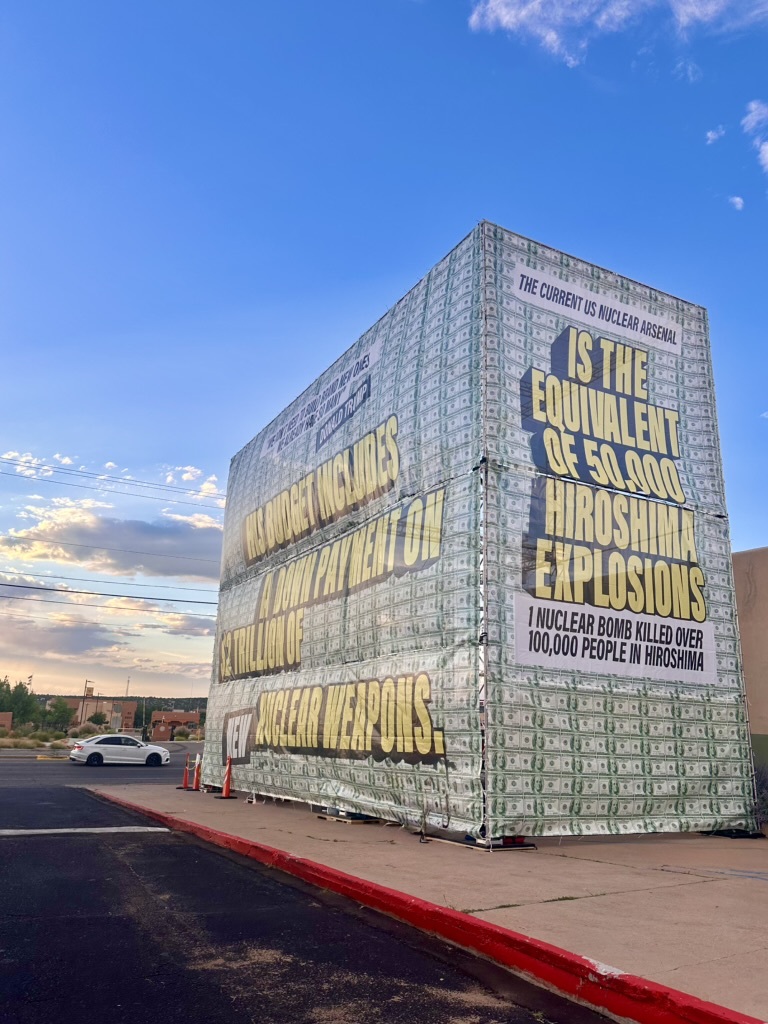





80 years ago the United States was the first country to start a nuclear war, today, ICAN stands with governments, survivors, and the global movement against nuclear weapons to make sure no nuclear war ever happens again.
On a hot and humid morning in August 1945, the US B29 bomber, called Enola Gay, flew over the Japanese city of Hiroshima and dropped the first nuclear bomb to be used in warfare. The atomic bomb dropped over the city killed at least 140,000 individuals. Many more died in the years following. Those who survived the bombing are called "hibakusha".
The hibakusha
The average age of the hibakusha is now 86 and they were almost all still children when they experienced the atomic bombing of their cities. They deserve to have their decades of campaigning vindicated and to witness the elimination of nuclear weapons in their lifetimes.
The hibakusha from Hiroshima, Nagasaki, and all nuclear weapons survivors are entrusting us with their stories.We must ensure their memories do not fade. By holding their memory, we carry their fight forward. #NihonHidankyo #NuclearBan #CranesOfMemory https://t.co/cUhwTaFM5N pic.twitter.com/DSV7BU9iBS
— ICAN (@nuclearban) July 29, 2025
A recent poll for Kyodo reported that 70% of hibakusha are worried nuclear weapons could be used again because of current geopolitical tensions. 70% were also critical of the Japanese government's disarmament policies, particularly its refusal to join the UN Treaty on the Prohibition of Nuclear Weapons, TPNW, which was created to prevent a repeat of the particularly inhumane, cruel and lingering impact these weapons have on human beings.
Hiroshima commemorations
An international commemoration and memorial ceremony takes place every year at the Peace Memorial Park in Hiroshima that serves as a reminder of the human toll of the attack.
We know from the testimonies of hibakusha and from rigorous scientific research spanning decades that nuclear weapons affect children in unique ways – due to the relative frailty of children’s bodies and their particular vulnerability to the harmful effects of ionising radiation, as well as children’s dependence on adults for their survival. This year, to remember the 38,000 children lost in the bombings, ICAN launched an online Children’s Peace Memorial.
The thousands of children killed in Hiroshima and Nagasaki are a reminder of the particularly inhumane and indiscriminate nature of nuclear weapons.
In Hiroshima, ICAN’s Executive Director, Melissa Parke, said “The average age of the hibakusha is now almost 86 and they were almost all still children when they experienced the atomic bombing of their cities and witnessed their relatives and friends being killed and maimed in cruel and lingering ways. ICAN is in Japan to honour them and their indefatigable campaigning which the nuclear-armed countries should vindicate by delivering what they have worked so bravely and so hard for - the final elimination of nuclear weapons in their lifetimes.”
Campaigning to eliminate nuclear weapons
The survivors of Hiroshima and Nagasaki have campaigned for decades for the abolition of nuclear weapons and last December the All Japan Confederation of A- and H-bomb Sufferers Organizations, Nihon Hidankyo, was awarded the Nobel Peace Prize in recognition of this work. The 80th anniversary of the events that changed their lives forever is the right moment for the leaders of nuclear-armed countries who congratulated them on their Nobel, to follow through on words with action and do what the hibakusha have called on them to do - join the UN Treaty on the Prohibition of Nuclear Weapons and disarm.
Across the world people are using these solemn commemorations to draw attention to the horrors of nuclear weapons- and the responsibility to work for their elimination.
Switzerland
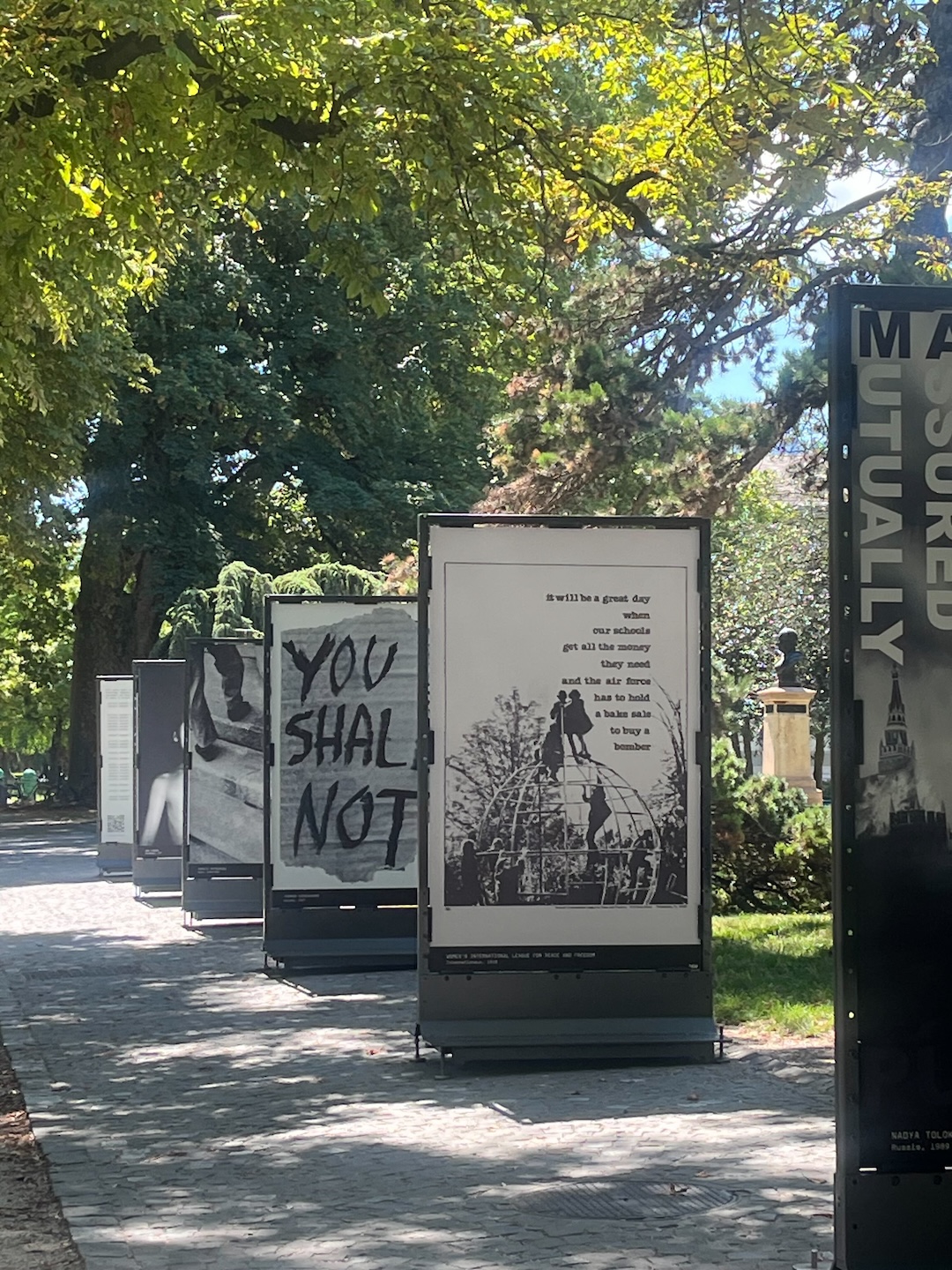
Geneva's Parc des Bastions features an Artists Against the Bomb exhibition running through the month.
South Africa
In South Africa, the South African Department of International Relations and Cooperation and the University of South Africa will host a seminar in Pretoria, "The United Nations at 80: The Post WWII Peace Architecture and the Nuclear Non-Proliferation Treaty"
African leadership on nuclear disarmament isn’t new.
— ICAN (@nuclearban) July 30, 2025
From the #Pelindaba Treaty to the #NuclearBan Treaty, African countries have long been champions of nuclear disarmament.
Learn more here: https://t.co/EIMVNZyTAa pic.twitter.com/4FfsBZAanH
France
In France, a new exhibition "Plus jamais Hiroshima & Nagasaki" will be running in Carrière-sous-Poissy 4-6 August, and at the festival Les Résistantes 7-10 August.
À l’approche des 80ᵉ commémorations d’#Hiroshima #Nagasaki nous alertons sur les contradictions du discours politique🇫🇷qui surfe sur la peur et renie ses engagements internationaux, alimentant la course aux arsenaux et l’insécurité #nucléaire#fildefensehttps://t.co/TD6lEYz2lG pic.twitter.com/9SdVzJLhJA
— ICAN France (@ICAN_France) August 4, 2025
Scotland
Across Scotland events will take place through the week, including at Faslane and in Glasgow.
Details below of Scottish CND activities countrywide this week, in commemoration of the 80th anniversary of the Hiroshima & Nagasaki bombings: https://t.co/e1hR7ubXc7
— Scottish CND (@ScottishCND) August 4, 2025
Australia
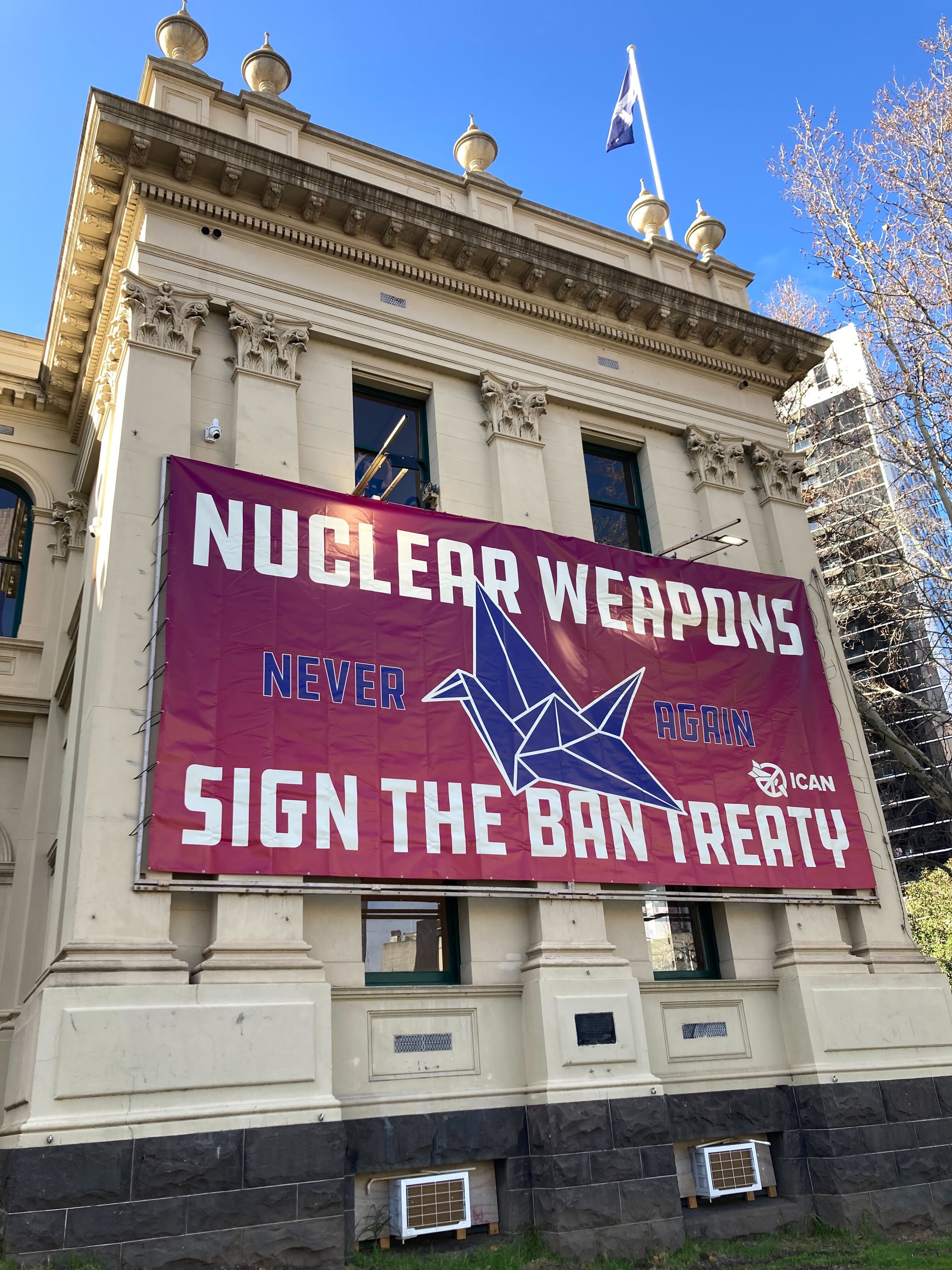
ICAN Australia offices displayed this banner.
United States
Hundreds of actions took place across the US to commemorate the bombings. In New Mexico, where the first nuclear weapons was detonated, a gigantic "Money Cube" structure was set up, as part of the “Up in Arms” campaign, to depict stacks of $100 bills in denouncing America’s $2 trillion nuclear weapons modernization program.