Kazakhstan has signed and ratified the Treaty on the Prohibition of Nuclear Weapons (TPNW). It was among the original 50 states parties to the treaty when it entered into force on 22 January 2021.
Signature and ratification
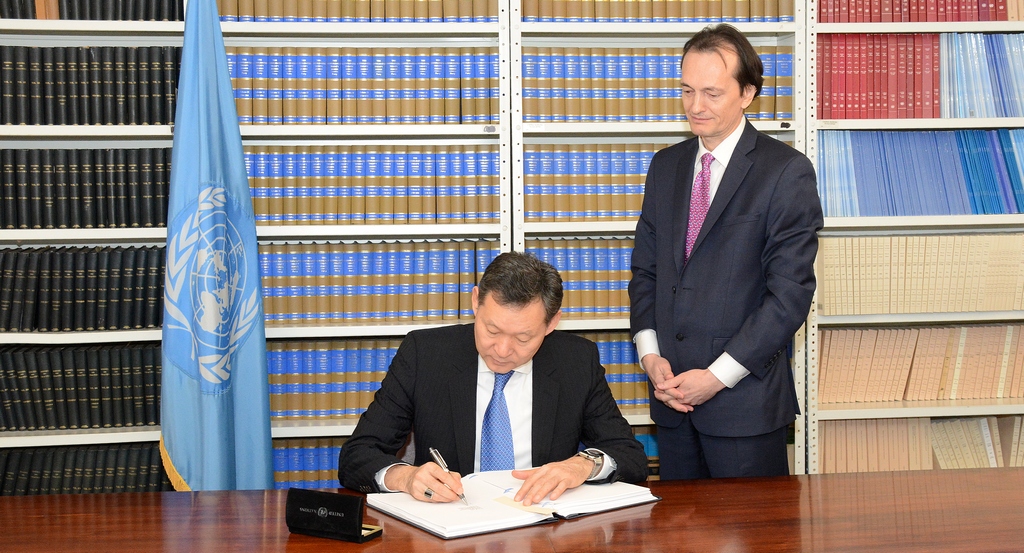
Kairat Umarov, the then-permanent representative of Kazakhstan to the United Nations, signed the TPNW in New York on 2 March 2018 and deposited Kazakhstan’s instrument of ratification with the UN secretary-general on 29 August 2019.
The date of Kazakhstan’s ratification coincided with the UN-sponsored International Day against Nuclear Tests, and also marked 70 years since the first Soviet nuclear test was conducted at the Semipalatinsk test site in Kazakhstan.
Kazakhstan was the 26th state to ratify or accede to the TPNW.
Ambassador Kairat Umarov of Kazakhstan signs the TPNW in 2018. Photo: UNOLA
Umarov deposits Kazakhstan’s instrument of ratification in 2019. Photo: UNOLA
National position
In 2023, Kazakhstan’s president, Kassym-Jomart Tokayev, pledged his country’s “continuous commitment” to the TPNW and called for “the complete renunciation of nuclear weapons by 2045” – the centenary of the US atomic bombings of Hiroshima and Nagasaki and the founding of the United Nations.
In 2021, he hailed the TPNW’s entry into force as a positive development.
According to Kazakhstan, the TPNW is “essential for effectively implementing” the Non-Proliferation Treaty (NPT) of 1968. “We join others in firmly reiterating the collective conviction that the TPNW and the NPT are mutually compatible and reinforcing,” Kazakhstan said in 2022.
Nuclear testing in Kazakhstan
From 1949 to 1989, an estimated 456 Soviet nuclear tests, including 116 atmospheric tests, were carried out at the Semipalatinsk test site, with devastating long-term consequences for human health and the environment.
“[M]ore than a million Kazakh citizens continue daily to face the tragic health consequences of radiation exposure,” Kazakhstan noted in 2023. “Over 18,000 square kilometres of contaminated land … remains uninhabitable. The TPNW is therefore not just a nuclear disarmament issue; it is, we are convinced, a human health and development imperative.”
Upon the break-up of the Soviet Union in 1991, Kazakhstan inherited approximately 1,400 Soviet nuclear warheads, which it subsequently relinquished, recognising that its security was best achieved through disarmament.
In an effort to gain wider international recognition of the importance of addressing the legacy of the use and testing of nuclear weapons globally, Kazakhstan, together with Kiribati, initiated the first-ever UN General Assembly resolution on this topic in 2023. It was adopted with the support of 171 states.
Karipbek Kuyukov (right), a Kazakh nuclear test survivor and artist, speaks with Setsuko Thurlow, a Hiroshima survivor, in Vienna in 2014. Photo: ICAN
Implementation
In accordance with Article 2 of the TPNW, Kazakhstan submitted a declaration to the UN secretary-general on 19 February 2021 confirming that it does not own, possess, or control nuclear weapons, and does not host any other state’s nuclear weapons on its territory.
It also confirmed that, in the early 1990s, all Soviet nuclear weapons on its territory were transported to Russia, while “all nuclear-weapons-related facilities [in Kazakhstan] were irretrievably eliminated”.
As required by Article 3, Kazakhstan has a comprehensive safeguards agreement in force with the International Atomic Energy Agency to guard against the misuse of nuclear facilities and materials. It also has an additional protocol in force.
Per Article 12, Kazakhstan has promoted universal adherence to the TPNW, including by co-sponsoring and consistently voting in favour of an annual UN General Assembly resolution since 2018 that calls upon all states to sign, ratify, or accede to the treaty “at the earliest possible date”.
In 2021, the then-minister of foreign affairs of Kazakhstan, Mukhtar Tileuberdi, called on other states to join the TPNW “as a tribute to all those affected by the use and testing of nuclear weapons around the globe”.
In 2023, Kazakhstan co-hosted a regional meeting in its capital, Astana, on the humanitarian consequences of nuclear weapons, as well as the complementarity of the Central Asian Nuclear-Weapon-Free Zone Treaty of 2006 with the TPNW. It hosted a similar meeting in 2024.
Together with the Pacific island state of Kiribati (which has suffered the effects of US and UK nuclear tests), Kazakhstan in 2022 appealed to “all states to join our work in providing nuclear justice for the victims of nuclear weapons by joining the TPNW”.
In 2024, the minister of foreign affairs of Kazakhstan, Murat Nurtleu, expressed deep concern at “the escalating rhetoric of nuclear threats” and urged all countries that have not yet joined the TPNW “to do so as soon as possible for the safety, stability, and survival of our world”.
In 2023, concerns were raised about Kazakhstan’s compliance with Article 1 of the TPNW after it allowed Russia to test-fire a nuclear-capable intercontinental ballistic missile into Kazakh territory. The TPNW prohibits states parties from assisting other states to develop nuclear weapons.
Kazakhstan convenes a meeting in its capital in 2022 to encourage other Central Asian states to join the TPNW. Photo:Kazakh MFA
Meetings of states parties
Kazakhstan participated in, and served as a vice-president of, the first meeting of states parties to the TPNW in 2022. Mukhtar Tleuberdi, the then-deputy prime minister, hailed the meeting as “a remarkable historic achievement following a nearly decade-long collective effort to advance the universal objective of complete nuclear disarmament”.
Together with Kiribati, Kazakhstan submitted a working paper to the meeting containing proposals for action to assist victims of nuclear use and testing and to remediate contaminated environments. The two states were appointed as co-chairs of an informal working group to address these issues.
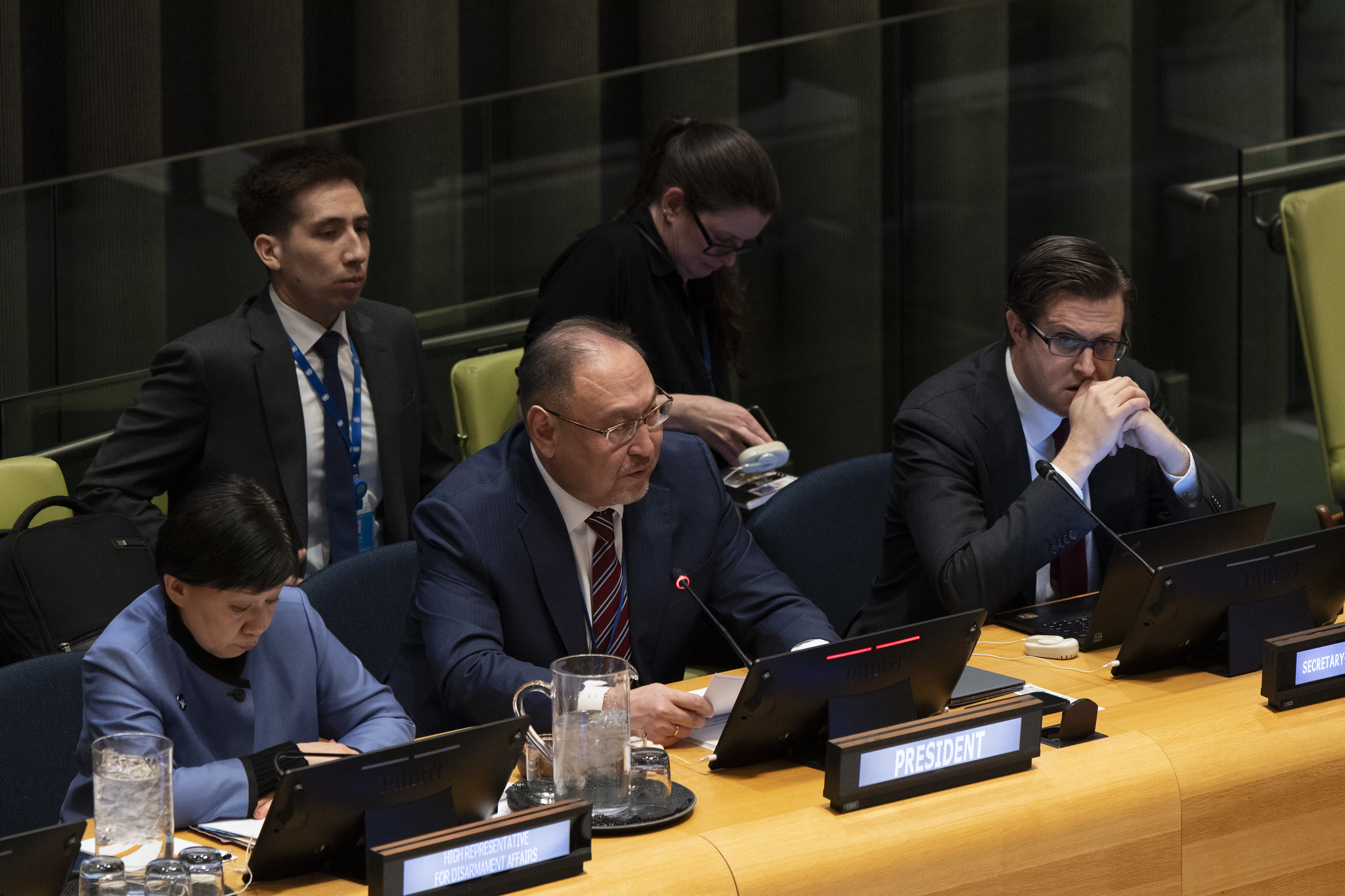
Kazakhstan also participated in the second meeting of states parties in 2023 and the third meeting in 2025, for which the Kazakh ambassador Akan Rakhmetullin served as president.
Kazakhstan’s priorities for the meeting were to establish an international trust fund for victim assistance and environmental remediation under the TPNW, to make progress in universalising the treaty, and to “encourage closer dialogue” between nuclear-armed states and TPNW supporters.
Ambassador Akan Rakhmetullin of Kazakhstan presides over the third meeting of states parties to the TPNW in 2025. Photo: ICAN
Kazakhstan addresses the second meeting of states parties in 2023. Photo: ICAN
TPNW negotiations
Kazakhstan participated in the negotiation of the TPNW at the United Nations in New York in 2017 and was among 122 states that voted in favour of its adoption.
In its closing statement to the negotiating conference, Kazakhstan said that it supported the treaty’s adoption because it has “a moral right and a moral obligation to pursue nuclear disarmament”.
Before the negotiations
In 2016, Kazakhstan voted in favour of the UN General Assembly resolution that established the formal mandate for states to commence negotiations on “a legally binding instrument to prohibit nuclear weapons, leading towards their total elimination”.
Kazakhstan was among 127 states that endorsed a “humanitarian pledge” in 2015–16 to cooperate “in efforts to stigmatise, prohibit, and eliminate nuclear weapons”. The pledge was instrumental in building momentum and support for convening the negotiations.
 Kazakhstan